Showing posts with label history. Show all posts

11 November 2018

Armistice Day

Today marks 100 years since the end of fighting in the First World War. It is Armistice Day. For the last few years as each centenary of the events of the war has come, I have seeped myself in the history. It’s no surprise to me my creative life has in the last few years been dominated by echos of the Great War. While writing the Sovietski for Palladium Books I studied the October Revolution and the early days of the Soviet Union to get capture some cultural notes from that period. I was even more drawn into the Great War by working on Wild Skies, my first original game, which is set in an alternate timeline where the war didn’t come to the same relatively tidy end we know from history. Last year I summarized the events of the whole Russian Revolution and its place in the war as near-daily updates on FaceBook. My newest project, called Never Going Home is horror role playing set directly in the trenches. With so many of my creative output focused on this war and its aftermath, I have to acknowledge this day.

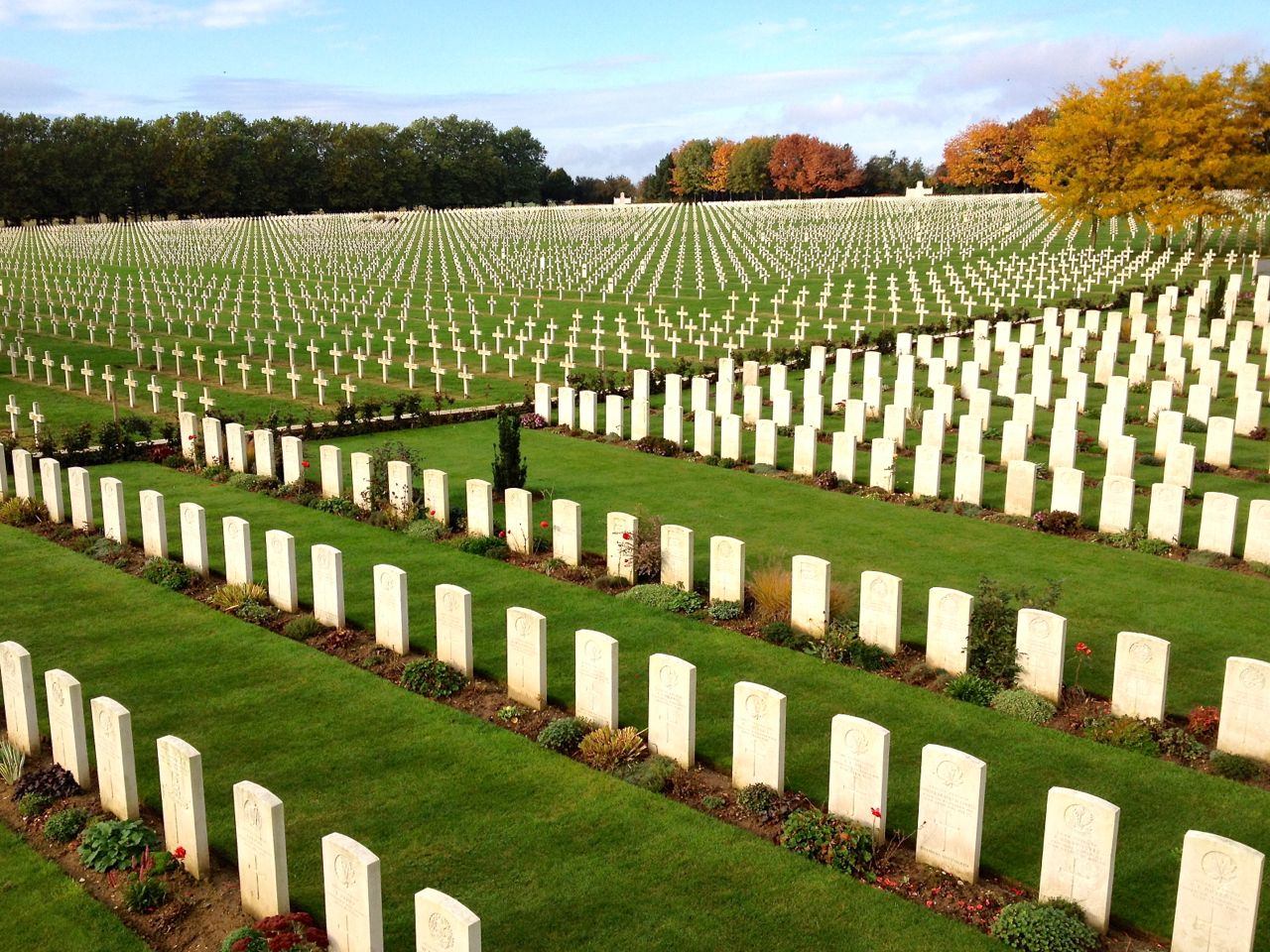
Especially this year, today is, for me, a solemn day for remembering the dead. I am staggered nearly to silence by the loss the war inflicted. The rough figure is 16 million people killed by the fighting; soldiers and civilians. With another 20 million soldiers wounded. That’s the war itself, not counting the Spanish Flu, the Russian Revolution, or the conflicts which simmered in the former Ottoman Empire into the 1920s. The numbers have a danger of becoming simply statistics. I find it more arresting to look at pictures of the graveyards which cover the former battlefields. Solemnly look with me.

What was the meaning of so much death? Famously, the war was supposed to “end all wars”, and that certainly hasn’t proven true in the last 100 years. How much more death have we seen then? Too much. Today, I am remembering all the dead. It’s very hard not to be cynical, but I want to celebrate the idea of peace the armistice of 1918 represents. We can stop fighting wars. We can move things to the negotiation table. We can agree not to kill anyone today. Peace is an idea worth working toward.

To be clear, I am not talking about shaking hands with people in my own country with different politics. That’s too easy. I am not saying there are not things like racial justice and clean water which are worth fighting for. There are! Voices must be raised, demonstrations staged, change demanded. I am talking today about questioning the need for weapons technology and political assumptions which lead to bombing villages from airplanes and building missiles capable of crossing oceans. I am affirming today, on Armistice Day, I want to live in a world without armed conflicts, proxy wars and national posturing in the form of military spending.

I know words matter. A call to memorialize all those killed by war is very different from a call to honor the sacrifice of soldiers. I will let others celebrate today as Veteran’s Day. Today I look beyond the need for military might to appreciate the possibilities of peace.

13 September 2018

Sherlock's Restless World

In 2012 I made it a goal to read the all Sherlock Holmes stories. I have now finished reading the four novels and 54 stories and I want to mark the occasion by saying something about them. This will not be a comprehensive review. That has already been done, and I am sure done better then I ever could. Other than the obvious things about the stories being influential on the crime drama, I really only have one observation. I kept noticing throughout the stories the way they seem to paper over a deep discomfort with the global aspect of the British Empire. As much as the Holmes stories are set so squarely in London in particular, and in Britain more generally, I can’t help but notice the source of the “adventure” in almost every case comes from without.

In the very first story, A Study in Scarlet, it is bad blood between some Americans which has led to a murder in London. There is a similar undertone of “foreigners are the trouble” in so many other stories. In “The Yellow Face” and “The Greek Interpretor” social issues of American and Greek immigrants respectively create mystery in England. The main antagonist in “The Speckled Band” was driven somewhat mad by service in India and in “The Solitary Cyclist” it was South Africa where the antagonist learned to be a brute. “A Scandal in Bohemia”, “The Naval Treaty”, “The Six Napoleons”, and “The Creeping Man” all turn on criminals, or unsavory characters from Europe making trouble in England. Less problematic, but still focused on the dangers of the world, are “The Blanched Soldier” about a tropical disease and “The Lion’s Mane” which is – almost comically – about an animal which isn’t usually found in England. Those are the ones which spring to my mind. I am sure there are other examples and probably counter-examples as well.

Problems come from outside. I don’t know nearly enough about the issues involved to know why this undercurrent exists. Is there an anti-Imperialist or anti-capitalist strain in Doyle’s politics which led him to publish stories showing the dark side of men who got rich in the colonies? Was Watson, as a wounded war veteran, framing Holmes’ exploits in terms of reveling the emotional damage of the Empire upon its citizens? Was Holmes himself simply a Englishman’s Englishman who took cases which seemed to smack of foreign interference? I can’t even be sure why the stories constantly return to the theme. Is it pro-Imperialist by suggesting Italians and Greeks can’t run their own affairs. It is anti-Imperialist by suggesting trying to conquer Asia will corrupt the average Englishman.

Whatever it means, it’s such a consistent theme, it can’t be in the stories by accident. Or can it? I am reminded of a series from the British Museum I heard about the same time I started reading the Holmes oeuvre: Shakespeare’s Restless World. Using objects like John Dee’s “magic” mirror, an oyster fork and a map of the world, the podcast identified the ways in which the rapid cultural, economic and scientific changes brought on by the European age of exploration found their way into Shakespeare’s work. It should come as no surprise Caesar bestrides the “narrow” world or that Prospero’s island refuge is hinted to be in the Americas. The New World and the horizons global navigation opened were on everyone’s mind. No one could avoid thinking about the implications. I think something similar going on with the Sherlock Holmes stories. Soldiers coming back from India with friendships they can’t really explain to society, people making fortunes and enemies in South Africa, the newest in scientific research leading to new poisons – all of these show up in the Sherlock stories and they all can be seen as expressions of another round of new horizons which British colonization projects and the increasing speed and ease of global travel were putting in the minds of Londoners.

I can’t help but think also think about Brexit and the America First rhetoric of my own country. Globalism has been upsetting since the 1590s, at least. I guess there is no reason I should expect it to be different today. I often say I like to look at how British culture has dealt both with empire and loss of empire because I live in country which has had its own time in the sun and is experiencing its own loss of global significance. Are there similar expressions in current American culture? Maybe Rouge One: A Star Wars Story, Black Panther, Crazy Rich Asians, and the conversations surrounding them are an expression of Hollywood’s Restless World?

10 April 2018

A Review: Hitler Moves East: A Graphic Chronicle, 1941-1943

5 of 5 stars.
For a while one of my “grail books” has been David Levinthal and Garry Trudeau’s Hitler Moves East: A Graphic Chronicle, 1941-1943. When I walked into a bookstore recently and spotted it on an endcap from across the room, I had to buy it. It is a reprint copy, but I am not a collector looking for first printings; I just want to look at the art.

I first encountered David Levinthal’s work as an art student. His work focuses on toys or models shot with dramatic light and in soft focus to create a kind of emotional verisimilitude. I once saw an exhibition of his Modern Romance series and I smile whenever I see his work on the covers of Sarah Vowell’s books. Garry Trudeau is well known as a cartoonist. I was interested to see what these two cooked up together about the Second World War.

The collaboration is described by Trudeau in the beginning of the book. He was trying to find the right historic photographs to illustrate a fictional story we wanted to tell about a Russian solder on the Eastern Front. Levinthal was working on a series of photos capturing the lifelike horrors of war without necessarily making realistic looking photos. They combined their efforts and rather than using real photos to illustrate a fictional story, they manufactured photos to illustrate the real history. There are real quotes and a few real photographs to round out the project. It becomes, as the title says, a graphic chronicle of the Eastern Front.

One thing that has stuck with me is Trudeau calling what they made a “paper movie”. It is such an odd phrase to read today when comics have triumphed as a medium and “graphic novels” can be of any genre and regularly make it onto bestsellers lists. I suppose in the mid-seventies when they were working on Hitler Moves East the concept of a “graphic novel” didn’t really exist. That was even before the “serious” comics revival of the mid eighties. Even though Trudeau went on to make comics himself, he couldn’t have called this project comics, it was a more serious work than than name implied.

As a long time comics reader and someone who loves “sequential art storytelling”, I think Hitler Moves East works. There are Trudeau’s words to tell you what happened at each stage of Operation Barbarossa and the selection of ephemera such as identification cards and propaganda posters lend their own authenticity. Then there are Levinthal’s washed out, or grainy, or almost over-exposed photographs of figures dashing through train yards, or hunkered in pill boxes, or laying cold and still in the snow. Much of the narrative impact is conveyed by the photos. The whole is surprisingly effective in giving the reader a hint of the ravages of war. It is a book one does not read so much as experience. That is what art does.

Just to be clear, though it has a similar name to another book about the Eastern Front, it does not share that book’s apologetics of the Wehrmacht.

07 November 2017

100 Years Since the October Revolution

100 Years Since the October Revolution Today is the 100th anniversary of the Bolshevik coup which brought them to power in Russia. If you have heard of the October Revolution, that was today. Yes, in November because Russia was still on the Julian calender and it was 14 days out of date by 1917. All this year, I have been following the time line of the Russian Revolution day by day. I’ve put up almost daily posts about the events on my Facebook page. I’m sure there are lots of articles about the revolution being published today, but since I’ve been following the 100th anniversary of the events all year I’ve had a long time to “watch” the way the whole Russian Revolution played out since the Tsar was first deposed back in March. I want to speak just a little bit about what I’ve learned and what lessons, if any, there might be for today.

I’ve asked myself over and over again; why were the Bolsheviks successful? They weren’t even the largest communist party in Russia and compared to the Russian population they were statistically insignificant. So, how did Lenin and Trotsky and all the rest pull off the coup? There is no doubt they were all committed revolutionaries willing to do anything. They were also very violent men who shed no tears for anyone who had to be killed to accomplish their goals. This doesn’t seem to be enough to explain the Revolution, though. There are committed, violent people who managed to make a mess or cause a scene all the time who are duly arrested and eliminated from polite society. Since the 1990s this has been the story in America over and over again. The bombers at Oklahoma City and Boston and those who attacked on 9/11 did not end America.

The thing I have seen over and over again by following the Russian Revolution day by day is that the structure of Russian civil society was so weak it had almost no resiliency at all. There were so few institutions other than the military and the Tsar’s bureaucracy. When moral was reduced to almost nothing by constant reversals in the Great War and the Tsar removed from power there were no other sources of authority for the Russian people to look to. I am thinking of the sort of people who regularly appear as talking heads on documentaries on news programs and on interview shows. Academics, sports figures, artists, politicians, entertainers, managers of charities; Russia had almost none of those kind of people nor the social institutions they represent.

Within the realm of government, after the abdication of the Tsar, the vacuum of power was filled by whomever could elbow their way in. The first new government formed by the politicians who had served under the Tsar was immediately opposed by a rival organization of political organizers who had been previously barred from politics altogether. Both of these groups had almost no experience with politics because Russia had only had politicians for twelve at that point. The two sides functioned as rival governments and were so hostile to each other the effect was for reasonable people on both sides to conclude they could do no good and left the stage. Each new vacuum was simply filled with progressively more oppositional leaders. I’m oversimplifying things quite a bit, but the pattern is clear. Those in power sought to accommodate a vocal minority, such compromises delegitimized those in power in the eyes of those opposed to compromise and they left the government, in effect growing the relative influence of the tiny minority. This happened over and over again until at the bottom of the barrel Lenin and the Bolsheviks were left as the only people who still wanted the job of leading the country. When the coup happened, those left to complain no longer had the power to do so.

Outside of government it seems everyone simply watched the power struggle unfold. The government had such little impact on the daily lives of people they concluded nothing happening in the capital would really impact them. It didn’t really impact them until the Bolsheviks won and began to spread their influence outside the capitol at the point of rifles. Again I am over-simplifying. The weakness of Russian institutions seems to have left the people of 1917 with the impression there wasn’t much worth fighting for. Not until soldiers showed up looking for the peasants’ grain did opposition to the Bolshevik regime really begin.

This year this story of the Russian Revolution has played out for me against the backdrop of the vitriolic political situation in America. It’s like watching one movie projected onto the front of a screen while another plays out projected against the back of the screen. Of course things don’t line up perfectly and there are certainly differences in degree. Yet there is some kind of harmony between them for me. There are lessons to learn. Every time I feel apathetic about the state of my nation’s politics I have to check myself. Apathy and fatigue more than anything else led to the victory of the Bolsheviks. It was more a slow, sad stepping away from power by all the other possible contenders than it was some glorious victory for the Bolsheviks.

That for me, then, is the lesson of the October Revolution 100 years later. Don’t give up on politics. Don’t give up on civil society. Don’t quit participating in the cultural institutions which make up a healthy society. We have something here which absolutely is worth fighting for.

12 October 2017

A Review: Rush to Judgment by Mark Lane

3 of 5 stars.

When reading about the Kennedy assassination, the idea of conspiracy and cover-up are always waiting in the wings even if the author doesn’t mention it. I figure it is best to go ahead and embrace that fact. As part of my reading, I what to read the best evidence from those who disagree with the official story. The first stop has to be Mark Lane’s Rush to Judgment. It appeared the year after the Warren Commission Report and proceeds from the supposition that any truth the Commission uncovered was not in the Report itself, but in the 26 volumes of recorded testimonies and statements made to the Commission’s legal team. Lane’s book, if nothing else, is a source for some of these extended interviews which offer readers a wider sample of what people said to the Commission. This quote from near the end of the book serves as a good abstract of Rush to Judgment:

“The Commission reviewed the testimony of 552 witnesses. Some of the testimony was inconsistent with other testimony, in sum or in part, and it was necessary for the Commission to evolve a standard for assessing it. I believe that it did so: testimony compatible with the theory of Oswald as the lone assassin was accepted, even when incredible, while incompatible testimony, no matter how creditable, was rejected.” p. 395

Mark Lane was hired by the Oswald family to represent Lee Oswald’s interests to the Warren Commission. Since there could not be a true trial owing to Oswald being dead, Lane acted as his defense attorney to the extent the Commission allowed. Having seen the sausage get made, so to speak, after the Commission issued its Report, Lane felt it was his duty to point out how far from “beyond a reasonable doubt” the Commission had actually proved its case. Lane points out time and again how key witnesses for the Commission would not have survived cross-examination. Witnesses frequently changed their stories and sometimes were led by Commissioner questions and other times all-but admitted to being coached by lawyers for the Commission. He also quotes numerous ways in which the Dallas police and Federal government representatives gave statements to the press which would have hindered a fair trial.

Lane attacks virtually every element of the Commission’s conclusions. Playing the defense attorney, Lane seeks to show the bullets which hit Kennedy weren’t fired from behind. They weren’t fired by Oswald. They weren’t fired by the rifle found on the sixth floor of the building where Oswald worked. The rifle found didn’t belong to Oswald. Lane does not present alternative evidence, he is only trying to poke holes in the Commission’s arguments using evidence collected by the Dallas police and Federal investigators which the Commission didn’t quote in its Report. If Lane has a coherent alternate theory about what happened in this book it seems to be there was a shooter of some sort on the sixth floor, but also another behind the fence at the top of the infamous knoll. Neither of these two shooters was Oswald, who was out front of the building at the time.

Sometimes Lane mounts an effective defense, other times less so. Take a couple short examples. He is pretty convincing when describing how the rifle tests, supposedly performed under similar conditions to the day of the assassination, were actually from a different height and a different distance than from the Depository window to presidential limo. “Could Oswald have made the shots?” has always been a pretty important question so maybe it is important to know the shot wasn’t actually repeated by the Commission. A weaker point by Lane is the medical report which estimated a 60 degree angle of entry for the wound in Kennedy’s back proves the shot came from too high up to have come from sixth floor of the Texas School Book Depository. I read that and have to ask what is more likely; the medical report is wrong about the angle or a shot was fired from some imaginary sniper’s nest high enough above the street that a 60 degree angle was created? I must conclude, as the Commission did, that the medical report was inaccurate on this point.

Lane does his best work throwing question on exactly what happened (and when) that led to the death of Dallas police patrolman J. D. Tippit in the Oak Cliff neighborhood. The Commission’s reconstructed escape route from downtown is shown by Lane to go well beyond what can actually be proven. From the unfair police line ups where Oswald was picked as the man seen fleeing the scene of Tippit’s murder, to the conflicting witness statements in the bus and taxi Oswald supposedly rode to the fact two types of bullets were found in Tippit’s body; there are holes in a narrative the Commission simply papered over with heavy-handed lines like, “Nevertheless, the Commission has concluded...”

“Perhaps the Commission thought that if Oswald spent a single moment unaccounted for between the assassination and the time of his arrest, it would be unable to deal effectively with those rumors, current at the time, of Oswald’s participation in a conspiracy. Its criteria for investigating and accepting evidence were related less to the intrinsic value of the information, I believe, than to its paramount need to allay fears of conspiracy.” p. 175

I think Lane’s assessment of the Commission’s goal to “allay fears” is spot on. The Warren Commission Report presents a complete narrative of what happened on 22-24 November 1963 and comes as close to answering the question “why?” as they can, considering Oswald was killed. To reach this clear narrative, they left out some of the details. In essence, they sought the “best fit” line of evidence through a lot of conflicting testimony. Lane spends this book pointing out that not all the data points are on the “best fit” line. While some of these points are interesting in their own right, it doesn’t really change the overall narrative. There will always be data which isn’t on the line. That alone doesn’t mean the Commission’s conclusions are wrong. To take one example Lane mentions over and over again. After the shots were fired many people converged on the area of the parking lot behind the fence at the top of the knoll. Many witnesses thought the shots came from this direction. Many others said they moved to or looked toward the area because others were already doing so. Lane assigns great importance to these initial reactions. My question, though, is what evidence was found there? No shell casings. No discarded rifle. No reports of people running from the scene. The knoll is a data point not on the line.

While Mark Lane’s book failed to convince me the official story is wrong, it did its job is raising questions about the Report and the bias of the Commission. I think Lane’s biggest success is in pointing to the evidence of how hard the Federal government and, even more so, the Dallas police worked to minimize their own failings as relates to the assassination. They should have done a better job to protect the president (and later Oswald) and they could have; they just didn’t because of their own assumptions and some gross miscommunication. I don’t think Lane has uncovered evidence of a conspiracy to kill President Kennedy, but it is interesting to see how much the Dallas police were working to save face by altering or omitting testimony and pushing time lines as much as possible and how much the Commission let them do so. To the extent there is a cover-up it is all in the mishandling of the evidence and witnesses after the event. That leads back to where this review started, the Commission couldn’t have proven its case in court, but for better or for worse, it never had to.

The last word will go to Lane himself, because I basically agree with him on this point. From page 207; “If historians are required to conjecture as to the meaning of the altered transcript,” or any of the other things which don’t quite add up, “the responsibility for such speculation must rest with the Commission.”

23 June 2017

A Review: The Warren Commission Report

4 of 5 stars.
For the last few years I have always been reading a series of books on a set theme in the background while I read other books. I read about a dozen books about the sinking of HMS Titanic and the destruction of Pompeii in the past. Now I have begun a series about the assassination of John F. Kennedy. I read Profiles in Courage which is by Kennedy, but I didn’t have much to say about it. I have just finished the report of the official investigation into the assassination: The Warren Commission Report. A text-only copy (with frequent OCR processing errors) is readily available.

How can one really even review this report? It is the text of the official explanation so I have heard most of the story before. If you happen never to have heard the official story before, it goes like this: President Kennedy died of a single gunshot wound to the back of his head. This shot and (only) two others were made by a single shooter from the sixth floor of the Texas School Book Depository. That shooter was Lee Harvey Oswald. The bullet fragments in the presidential limousine were fired by the gun found on the sixth floor. That gun was bought by, shipped to and photographed with Oswald months before the assassination. No evidence of material, logistical or planning assistance of any kind from any source was uncovered. Jack Rudy killed Oswald two days later for his own reasons and had no previous connection to Oswald or any other conspiracy. I didn’t find any unreasonable leaps in logic or gaping holes in the Commission’s theories given the information presented. Re-examinations of the case usually start here. All alternate theories must be mounted in opposition to this body of collected information.

What a massive body of information the Report is, too! It is 888 pages including footnotes and is based on what must be thousand of pages of sworn testimony and depositions by eye-witnesses, experts, government officials, and family members and acquaintances of Oswald and Rudy. Since I watch a lot of non-fiction crime shows I am familiar with fingerprint evidence, microscopic comparisons of firing pins and bullets, and question document examination. All of these were used to match the evidence to Oswald. All of these lines of evidence are explained in detail for people who in 1964 had seen fewer episodes of Forensic Files than I have. A bullet matched to a gun, matched to a suspect, who was seen in the area before, during and after the assassination is strong evidence. Plenty of people have been convicted of murder on less. Though, to be fair, and the Report itself points this out, since Oswald was dead by that time the Commission was not bringing evidence to criminal trial so not all of the evidence gathered quite rises to that high level of proof. Case closed!

Unless all the evidence is manufactured, of course... In many ways, reading this report in the 2017, after the Gulf of Tonkin incident, after the Watergate scandal, after the Iran-Contra affair, after actual impeachment hearings against a sitting president and that whole “we were wrong about WMD” misadventure it becomes impossible not to think of the possibility the Commission was lied to. The Report makes constant mention of whom the information reported comes from. About half of the information is “according to the FBI” or “according to the Secret Service” or “according to the Dallas Police” or (even!) “according to the Soviet Union’s embassy in Mexico City.” Are these really trustworthy sources of information?! Maybe in 1964 they were. The Commission certainly had faith in the reports and records turned over to them by other government agencies. As the biographies of the commission members make clear, some of them were literally born in the Nineteenth Century! There was criticism of the trusting nature of the Commission even at the time. Overall, it seems that was a simpler age and there is something beautifully old-fashioned about the Report and its tone of assurance.

Speaking of beauty, the part of the Report I find most striking is the domestic portrait it paints of Lee Oswald and his Russian wife, Marina. (Since her family was from Minsk, she’s probably Belarusian, but these intra-USSR distinctions were not the concern of the Cold War-era Commission.) After concluding Oswald was the assassin, a large part of the report and a very long appendix (Appendix 13) deals with all the minutia of his life. Perhaps the Commission was intending to encourage disdainful pity, but to me, he comes across as very nearly sympathetic. He never really succeeded at anything in his life and he ended up bitter about it. Born into humble circumstances and never able to rise above them, he was a loner and a constant reader who had big ideas he was never able to put legs under. I see something of myself in that biography. He became disillusioned of the American system, but after living in the USSR, he learned that wasn’t really any better. The only positive he took from Minsk was his marriage to Marina. They seem to have come to care for each other, but initially they both married to spite previous partners. I want to know much more about Marina. She is a major source of the Commission’s information on Lee, but she is not the focus of their investigation. After the Oswalds came to the US, Lee seems to have been searching for some way to make a big splash and become important in the political scene in the way young people often do. He was 24 at the time. He bought a gun. Missed a shot at a right-wing ex-general. He tried to start a pro-Cuba group and found no support. He tried to go to Cuba and they didn’t want him. Then he read on a certain Monday the President would be passing below his office window that Friday. He never got the advice Holden Caulfield did about living for a cause rather looking for a way to die for it. To me, that’s just another tragic part of what is an American tragedy on almost every level.

30 September 2016

A Review: The Fires of Vesuvius by Mary Beard


4/5 stars.
This is the last book in my years-long quest to read ten books about Pompeii in the order they were written. Since The Fires of Vesuvius: Pompeii Lost and Found, from 2008, is the most recent of the books, perhaps it is impossible for it not to be the best. It contains the most up-to-date information about the site and there is no old fashioned wording or style issues which slowed down my reading of some of the other books. It is not just these elements, however, which made this into one of the best in my series. Firstly, there is just more to the book. I learned about specific finds and whole parts of the town no other author had mentioned. The main thing I liked was the approach the author took to the material. She is an archaeologist and she talks about Pompeii and the finds from the city in strongly archaeological terms. I have always had a love of science writing which lays out the evidence in the form; “We know this, because we found this.” Beard brings more of those kind of references per page count into her book than any of the other nine books in my series.

To mention only a couple examples; we know the town was still populated by speakers of (the Italian but not Latin language) Oscan right up to almost the end of the city because there are street signs in Oscan which were painted over only during the post-earthquake renovations of 62 CE. The history of Pompeii as a town of Italians (but not Latins) which was punished for opposition to Rome by being forced to take on a bunch of Roman veterans is revealed right in those painted layers. We know the town was re-entered after the eruption, for hundreds of years, by looters looking for things left behind because coins minted up to 200 years later have been uncovered in the ruins. There are layers upon layers upon layers of history on display in Pompeii when you know what to look for and Beard does a fantastic job of taking the reader through them.

Having read Harris' novel Pompeii not too long ago and enjoying how lively he made the town seem, I was struck by how much more lively Beard made the town seem with her non-fiction. Unlike most of the other non-fiction I have read about Pompeii, Beard does not make the buildings and the objects they hold her focus. She uses the information from the physical remains to illuminate what the people were doing in the spaces they inhabited. Millstones, donkey bones and perfectly preserved loaves of bread are one thing, but Beard paints instead a picture of a middle-class family doing a tidy business in bread and catering. What kind of people were the Romans? Beard answers the question from several angles. She covers business, politics, religion, leisure, death and a few other things. She does this while keeping the people themselves, a good number of whom we know by name, her main focus.

Another element of her approach to the story of Pompeii is an aspect of her training as a scientist. I have read works on the past by journalists and historians who draw from many sources then present the “best fit” of what happened. Beard prefers to speak about ranges of possibility. She pulls from competing historical interpretations, and interjects her own opinions, but leaves things at that. There were over 600 brothels in Pompeii, or only one, depending on how one defines what makes a certain building a brothel. Romans where either deeply pious, with household gods and statues of their divine emperors at major crossroads, or they were merely traditionalists who hated to see the old ways fade away and maintained their shrines long after they had any personal meaning. Sometimes we can't be certain what particular stones, statues, gouges, reconstruction projects or painted slogans mean. By offering the range of possibility then focusing on what can be known for certain within that range, Beard offers the reader both a stunning picture of ancient life as the sort of messy, complicated life we can recognize and proof of the solid results which can be achieved by the exacting science of archaeology.

Simply because of its massive scope, Mommsen's tome on the history of the Roman Republic is still the best book I read is this Pompeii series. However, Beard's Fires is a close second and is certainly the best book specifically about Pompeii I have ever read.

15 September 2016

A Review: Pompeii by Robert Harris

3/5 stars I first heard part of this book read on the radio back when The Radio Reader was a thing on NPR. I remembered it being pretty good. There were also literally stacks of copies in the gift shop of the museum where I saw the Pompeii exhibit which got this whole Pompeii reading series started. So, I knew of the book and I knew I had to read it. I got it from the library and blew through it in a weekend. It is not a dense book. I hesitate to call the author a hack, but this is not great literature. It is a very accessible thriller. The story gets a pass from me, though, because of the innovative choices Harris made in his approach to the material. I also enjoyed the explicitly modern volcano science which kicked off each chapter and suffused the climax. Yet, by the end I felt the novel was missing something. Now, like magma squeezing up into a lava tube and inflating the cinder cone, I'll expand these points a measurable amount.

The plot of the book is this: Marcus Attilius Primus is a young aquarius – a hydrological engineer. He has just been assigned to take over management of the aqueduct running along the Bay of Naples after the previous aquarius disappeared. So, the book starts with a mystery. Then the mysteries start to pile up when first the water in Attilius' home base of Cumea turns sulfury and then a report comes in of the failure of the aqueduct altogether. To prove himself in his new role, Attilius rises in the face of these mysteries and sets about the solve them one by one. Like most good mystery stories, all the disparate elements start to come together into one big mystery. Attilius convinces General Pliny, a famous polymath, he can do the job, but in Pompeii he runs afoul of Ampliatus an ex-slave turned real estate mogul. Perhaps inevitably for a thriller, there is also a young woman who turns Attilius' head. Unfortunately, Corelia also happens to be the daughter of Ampliatus. All of the plot lines come to a head, on the day of the famous eruption in 79 CE and the climax plays out during the eruption itself.

I like Attilius as a protagonist. He's young enough to be a bit reckless; but as an engineer, he takes time to think through a problem before acting. Not that I mind a good meaty-fisted protagonist in this kind of story, but I like that Attilius isn't that kind of man of action. I also really enjoy the life Harris breathes into the rhythm of Roman life. The way he discusses how the aqueduct works and the cultural systems in place to access the water give me a picture of the Romans I didn't have before. I don't know personally if they are accurate, but Harris describes the road network and the role of slave labor and the lives of leisure enjoyed by the wealthy in their coastal mansions in terms which seem entirely plausible. While there are good elements in the story, there come along with some bad elements. First, Ampliatus as the villain of the piece had mustache-twisting levels of cliché. He is vain, spoiled, corrupt, merciless, manipulative, all the adjectives really. Secondly, the story is just a little too pat. There's one source of all the problems, the only woman and young hero every meets is the one he falls, every insane and risky thing the hero tries works out because he's the hero and if he died on page 50, there wouldn't be 150 more in the book. I guess it's not really a big complaint. It's a summer vacation or airport-reading style thriller. It isn't supposed to be a challenging read and it sure isn't.

I do want to step back to praising the book for a moment. Each chapter begins with a quote from a modern scholarly work on volcanology specifically talking about what was happening in the earth under the Vesuvius before this eruption. Harris quotes a scholar about how tremors would have preceded the final eruption, then the chapter begins with Romans sweeping up their broken pots. The last third or slightly more of the text takes place during the eruption itself and Harris' descriptions of the stages of the eruption – particularly the pyroclastic flows which buried the city seem quite realistic. Speaking as someone whose volcano knowledge only consists of being old enough to remember the news coverage of the Mt. Pinatubo eruption in 1991 and reading the volcanology blog Eruptions, I felt like Harris got all that science stuff right and actually offers some science “value added” for the general reader to know what's happening as the setting of the story itself tears itself apart. These modern snippets are, of course, anachronistic for the text, but I think the contrast really helps shed new light on the events for me. When you get scholarly discussion of modification of the environment and CO2 degassing then the first century characters talk about giants shaking the foundations of the earth you realize they had no idea what they were up against. They had no chance against the forces at work below their feet.

That brings me back to the “something” which is missing from this story. When you sit down to read a story set during the final days of Pompeii, you know from the beginning everything is going to be covered in pumice at the end. That is no “spoiler” 1937 years later. Harris has put the material culture of the Romans front and center in the story with his focus for the first part of the book on repairing the aqueduct. The reader knows all the fancy buildings and fish ponds and villas Harris describes, and the aqueduct as well, are all going to be covered in pumice by the end. It tends toward tragedy in the classic sense. Attilius' heroic efforts are for nothing because pumice. Pliny's rescue mission is for nothing because pumice. Ampliatus' schemes are for nothing because pumice. The images of the characters preserved in the ash could have given some kind of bittersweet import to the events. Instead, Harris ends with a more ambiguous fate for the central characters. We are given a little bit of hope, but the idea is so undeveloped as to be almost no hope at all. It's as if Juliet's nurse shouts, “They're not dead yet!” as the curtain falls. It doesn't convert the story into a comedy, it is just confusing. Maybe I am asking too much from a book which is so obviously a light, easy read. I recommend it, and enthusiastically, for it's unusual subject matter, it's breezy pace and for it's vivid portrayal of ancient Roman life.

15 June 2016

A Review: The History of Archaeology by John Romer

3/5 stars.
I grew up with John Romer's history programs back in the days when you could actually learn something on The Learning Channel. This is first book of Romer's I have read. As part of my on-going series, I wanted to see how the (re)discovery of Pompeii fit into his narrative of the development of archaeology as a science. The books is subtitled; “Great Excavations of the World.” I hoped it would be a chronological, example by example look at how archaeological techniques and knowledge were developed. The book is organized more topically and focuses mostly on the Nineteenth Century. It was an enjoyable read, but I don't know that it was all that informative and certainly not a very important work in the field. It felt very much like the companion book to a television show, which of course, it is.

The broad topics Romer covers are: Hey! There's old Stuff in the Ground. Hey! There's treasure in the Ground. Stuff in the Ground Proves the Truth of Literature. Which Culture is Really the Oldest? Stuff in the Ground Proves the Rightness of My Politics. In each of these categories, Romer gives ten to fifteen examples of the development of knowledge or, more commonly, competing interpretations of the same information. This back-and-forth, vignette approach gives an over-all impression of the professionalization of archaeology and the contributions the field has made to human knowledge. This “general impression” result of the book is not exactly a bad thing, but I hoped the text would be more precise. Combined with Romer's very personal writing style, most of the book ends up being an assortment of report about what John Romer thinks about various things, not a coherent, supported presentation of history. For me, that holds the book back.

Many familiar figures are covered; Elgin in Greece, Belzoni in Egypt, Schliemann in Turkey, Petrie in Greece, Evans in Crete and Carter in Egypt. The book also introduced me to others I didn't know; Pitt Rivers (who invented methods of diagramming a site's layers which are still used today), Auguste Mariette (who championed keeping Egypt's history in Egypt), John Stevens and Frederick Catherwood (who followed local guides into the jungle to make the first detailed reports of “lost” Maya cities), and James Breasted who (secured massive corporate sponsorship to conduct extensive surveys of Middle-Eastern sites).

So, what does this book have to say about Pompeii? There are three short sections at the beginning which use Herculaneum and Pompeii as jumping-off points to the themes of the book. In 1980, the docks at Herculaneum where excavated which revealed the actual people who had fled from the volcano is 79 CE. The most striking image being the skeleton of a slave woman clutching the child of her wealthy owners. The interest in the people and the echoes of the society in which they lived was the primary motivation of the excavation. How far from where archaeology started. Back in 1736 when excavations first began in earnest, Herculaneum was just a source of decorations. No one considered what could be learned about Roman life from the remains. Even after Pompeii was uncovered and scholars could see the reality of the world described in the surviving Roman literature they treated Pompeii as more of a blank slate onto which they painted their impressions of the past than as a new source of information. Romer doesn't quite make it explicit, but it seems to me his book is an explanation of how we got from Herculaneum in 1736 to Herculaneum in 1980.

01 June 2016

A Review: Pompeii by Roger C. Carrington

4/5 stars.
The next in my continuing series of books about Pompeii is the aptly named Pompeii by Roger Carrington. I got my copy from AbeBooks. The book was published in 1936 which places it squarely between the Nineteenth Century stuff I have read previously and the recent works I have yet to read. Unlike reading a digital copy, it was a constant joy to hold this eighty year old in my hands. The text is full of figures, mostly the plans of houses and temples, and there is a series of photographs at the end as well as a fold-out map of the extent of the excavations as Carrington knew them.

There was much to love in this short book. For the first time (among the books I've read) Carrington gives a full account of the re-discovery of the town. Actually, he starts with the rediscovery of Herculaneum, which was a working-class town around the bay from Pompeii, buried by the same 79 CE eruption. An attempt to sink a well in 1709 turned up sculpture instead. Workmen had tunneled down into the town's theater. For over 100 years, the theater and surrounding buildings were treated like a sculpture mine. I cannot help but think of the Pejite engine mine in Nausicaä. Excavations in Pompeii itself began in 1748, where the layers of ash and lava were thinner, but not until 1860 was systematic archaeological methodology begun.

The emergence of archeology as a science is what most informs Carrington's account. Gell gave a description of the ancient city itself. Bulwer-Lytton used it as a setting for a drama. Carrington takes a ground-up look at the life of the city. He uses facts like which buildings were in use when and how certain items were found stored to tract the changing culture of ancient Campania. Greek, Etruscan, Samnite and Roman influences are all tracked in turn through changing floor plans of country villas and the diverse materials used to build and rebuild city homes. Carrington discusses what can be known about politics in the city from the slogans found painted on Pompeii's walls and what can be known about religion from which temples were most recently renovated. I love archaeological accounts where the author says, “we know that because we found this.” Pompeii is full of that kind of information.

The weakness of Carrington's book is that his account is one largely of institutions. It is an account of merchant guilds, classes of workers, religious cults and political parties. There is little mention of individuals, despite many known names from the city. As I have mentioned before, I have long associated Pompeii with the plaster casts made from the impressions left by those caught up in the disaster. Carrington does mention these plaster casts, but only in passing in the appendix on visiting Pompeii. I suppose this is because the text focuses more on the life of the city than its death. Even so, it seems to me the actual remains of the actual people would be a great way to focus on the fact the city was full of people. Perhaps it was not “proper” in 1936 for a classicist to speak casually about the dead.

I enjoyed reading this book and I learned about the culture of the city. What more could I want?

17 March 2016

A Review: The Innocents Abroad by Mark Twain

3/5 stars.
I don't remember how I learned Mark Twain covered a visit to Pompeii in this travelogue. I generally enjoy reading old travelogues because they describe a world which doesn't quite exist anymore. To me, it is akin reading about a fantasy world. There is also an historical interest because the author inevitably talks much about his or her own sentiments and ideas. Thus the modern reader learns something not only about the place the writer visited, but also something about where the author is from. All that being said; “Mark Twain goes to Pompeii” seemed like something I should read in my series of books about Pompeii.

First off, there is very little about Pompeii in this book. The book covers a five month cruise all around the Mediterranean, so the buried city only forms part of one chapter (XXXI). About the only thing of note he mentions (revealing something of what was commonly known at the time) is when he thought about visiting a buried city, he imagined it as still buried and exploring it by torchlight after climbing down into the mine-like excavation. He was surprised to see it was all uncovered and open to they sky. I find this odd. Twain makes frequent mention of the guidebooks to European and Near Eastern travel the “Innocents” he traveled with had to hand for their journey. How had he missed the fact the city had been completely uncovered even though he knows of the upright soldier mentioned by Gell? Twain writes:
We never read of Pompeii but we think of that soldier; we can not write of Pompeii without the natural impulse to grant to him the mention he so well deserves.
Apparently, we still cannot.

Beyond the single chapter for which I read it, the book was just alright. The pleasure cruise Twain went on took place in 1867 and many of the chapters were sent home as newspaper reports. The book is a reworked version of these newspaper pieces together with many illustrations and Twain's fuller reflection upon the events of the trip. There are many incidents which strain credulity, but this is hardly surprising from a man who is remembered as a satirist. I particularly enjoyed his discussion of Venice (XXII), his night time visit to the Acropolis of Athens (XXXII), his luncheon with Tsar Alexander II in Yalta (XXXVII) and I liked the perspective he brought to his horseback ride through Syria and the Holy Land (XLII - LVI). There were also moments, most strikingly in Chapter XVIII, where Twain wonders off into memories of his childhood and youth. I want to know more about the person he describes in those fleeting moments. I have added Twain's autobiography to my reading list.

These enjoyable moments are scattered throughout a large book full of a lot of bad-mouthing of everything. He lampoons his American shipmates and himself, but he gives his worst to just about every else. He goes on about how the Old Masters weren't so great. He points out how nation after nation is run down and reliving old glories. He describes the French and insufferable, the Italians as beggars, the Turks as barely human, the Syrians as dirty and on and on. The American newspaper audience of the late 1860s seems to have had quite the taste for this sort of ruthless dismissal of the Old World, but I do not.

I am at a loss to guess how much of what is in this book is the real Mark Twain and how much was what he felt he needed to say for the papers. (I am aware there is some irony in asking what is real when talking about a man who created a fictional persona for himself.) This book was written early in his career when he showed promise as a writer, but before he became famous. Hints of the biting social criticism he later became known for are evident in this book, but he doesn't yet seem to know how he wants to wield his voice. Again, I want to read more of Twain to see how that development occurred.
In his conclusion, Twain says this:
It would be well if such an excursion could be gotten up every year and the system regularly inaugurated. Travel is fatal to prejudice, bigotry and narrow-mindedness, and many of our people need it sorely on these accounts. Broad, wholesome, charitable views of men and things can not be acquired by vegetating in one little corner of the earth all one's lifetime.
I couldn't agree more.

02 March 2016

A Review: The Last Days of Pompeii by Edward Bulwer-Lytton

4/5 stars.
The next in my series of books about Pompeii is my first work of fiction on the subject, and possibly the first ever fictionalized account of Pompeii. The Last Days of Pompeii was published in 1835, and coming so close in time to Pompeiana, I expected it to pull liberally from Gell's descriptions. It did. In fact, Gell and the etchings from Pompeiana are explicitly mentioned. Bulwer-Lytton was clearly not bothered by inserting his authorial presence into his narrative nor by breaking into the ancient events with comparisons to the modern day. Asides such as “and you can see this same room when you visit the city today” or “they had a meal much like our own afternoon tea” stand out in sharp contract to the tale Bulwer-Lytton has crafted. He goes so far as to mention he can see the Bay of Naples he is describing from the desk where he writes the book! The mansion on the street of tombs just outside the city, the gladiators, the stalwart soldier whose skeleton was found still erect at his post and numerous other things mentioned by Gell are all folded right into the novel. Instead of being a real distraction from the novel I found I got used to Bulwer-Lytton's style and came to enjoy the specificity of his writing. “You can see the spot I'm describing. You know the type I'm talking about.”

I also enjoyed the actual story of the book. Not so much for the main story, which is what I would call a novel of manors, but for the numerous side stories which are woven together. The main action of the story is a tale of young love between Glaucus, a young Athenian nobleman, and Ione, an Italian-born woman of Greek heritage. Around these two are a constellation of other characters. Ione is the ward of the Egyptian priest Arbaces, who fancies Ione for himself. Ione's brother is Apaecides, who serves Isis with Arbaces but converts to Christianity. The blind slave girl Nydia sells flowers and fancies herself beloved of Glaucus. The rich and spoiled Julia also wants Glaucus for herself. Further from the center of action are the other Christians of the city, the gladiators, Glaucus' vapid friends and a Witch of Vesuvius, living in a cleft on the mountain. I don't generally care for stories where nothing “happens.” There is little which happens in this book. Most of the text is about the way people feel and how the scene looks and the history of Roman culture which explains why people are doing what they are doing. Taken all together, the story becomes more than the sum of its parts. Pompeii, as preserved in ashes in 79 C.E. is a crystallized moment in time and Bulwer-Lytton has taken pains to explore every facet of this chunk of Pompeiian amber from every angle. He has woven his tale into a vivid portrayal of the life of the city itself. I like the approach.

The novel explores many different point of view, but I found two perspectives particularly interesting. The first is the way the Egyptian and Greek characters feel about the Romans. Arbaces the Egyptian is an astrologer and rumored sorcerer. His contempt of everyone around him comes from his feeling of superiority as he views Egypt as the Mother Race and all these Mediterranean usurpers as mere children to do with as he pleases. His hates the Romans and mocks their accomplishments, yet he lives in a Roman city, enjoying the finer things. His views seem to mirror more the ideas of the Nineteenth Century than the facts of the First, but that isn't really a surprise. Through Glaucus, the feelings of the surpassed Greeks are also explored. He is also described as living a life a pleasure, always seeking to forget the fallen cities of Greece. From reading Mommsen, I have a general sense of how the Romans interacted with and treated both the Greeks and Egyptians so I find it fascinating to explore some of how those people may have felt in their day-to-day lives.

The other perspective Bulwer-Lytton explores at length is the nature of early Christianity. Apaecides, who rejects Isis for Jesus, is led in his conversion by Olinthus, who is presented as a passionate preacher and something of a zealot for his young faith. Olinthus is, perhaps too stereotypically, sentenced to face a lion in the arena after he is arrested as an atheist for denying the existence of the Roman pantheon. Other Christians are presented as a bit more calm and contemplative, but all of them conduct themselves with restless energy and powerful certainty. Bulwer-Lytton points out this fresh fire has been somewhat diminished in the present. He doesn't seem to be opposed to Christianity in principle, but he is critical of the methods of the early believers.

As the novel goes along the cast gets more and more intertwined. Their fates all march forward to an ending in ashes. Even if you didn't know about the Vesuvius eruption and the way the city was buried, the title The LAST Days of Pompeii should clue you in something is going to happen. Bulwer-Lytton has done a great job a working in hints of the coming destruction which the reader can hardly fail to miss but which the characters consistently mistake. They laugh off omens or produce talismans against the evil eye as if they can be saved. For instance, early on Arbaces reads in the stars he is in danger from a falling rock and he is indeed smote by a falling statue during a scuffle with Glaucus, but lives. He thinks all danger is past, but from then on I expected him to be killed by a falling chunk of rock from the volcano. It's these little touches which make this book more engaging than its conventional tale of young lovers would otherwise be. The threat of doom looms over the story and as a reader nearly 20 centuries later you know it doesn't end well. Early on, I hoped the book would come to an end before the story was told. I hoped the author would leave his story unfinished to mirror the sudden end to all the stories of the city.

I got fully wrapped up in the story. This was perhaps helped by not actually reading the book, but listening to it through LibraVox. It is nearly seventeen hours long. There is a wide range of volunteers who read the chapters and their diverse pronunciations of the Greek and Latin names can be a little bit distracting, but overall it is nice to lean back and let other people deliver the story to my ears.

03 December 2015

A Review: Pompeiana by William Gell

3/5 stars.
A few years ago I went to an exhibit in Cincinnati of artifacts from Pompeii. I've known the basics of Pompeii, as I assume most people do, my whole life; Roman city, buried in volcanic ash, found centuries later, the forms of dying people preserved where they fell. Seeing the exhibit, though, gave me a new sense of the value of the site to our understanding of the early Roman imperial period. Pots and statues, graffiti as aggressive advertising, the bread, olives and figs they ate: all of it preserved for us to study or gawk at, depending on our skills and interests. Of course, the paster casts of the hollows where people fell were arresting. Literal moments frozen in time. It was amidst all this archaeological wonder I found one sign which mentioned the first book written in English about Pompeii was Pompeiana from 1817. I resolved to read this book. Thanks to the wonderful people who digitize old books, it wasn't that hard to find online.

I have the impression, based on I don't recall what, the book was going to be a tour guide of the city. I expected it to describe both the city and the methods by which fancy English gentlefolk on the Grand Tour would get to and around the town. I wanted to read about Sergio who has the best and most reliable mules in the area and about Momma Caglione who prepares the finest meals. There was none of that sort of tourist stuff. It was just about what a person will see in city. I suppose I should have guessed that from the full title: Pompeiana; the Topography, Edifices and Ornaments of Pompeii.

The book is actually rather short. It goes over the known and supposed history of Vesuvius' eruptions. Then the major parts of the city as known at that time. I read the second edition from 1824, which says it has been updated in include some recent excavations. Even so, there wasn't much of the city known at the time. The amphitheater in the east was known but the middle of the city was still buried. Gell instead covers the buildings on the western edge of the town. The tombs and large houses on the main road outside the Herculaneum Gate, a few of the crossroads, a few of the temples; these things he discusses in detail giving count of rooms, supposed uses and any curious artifacts found in each. The frescoes and mosaics one would see in each building are also listed and described. What I liked best about the book was the numerous plates throughout. About every house and building described is also figured by good quality lithographs and many are given a numbered plan as well. The over-all impression of the book is to put the reader “there” in a very literal way.

The book serves as a time capsule because it shows things in Pompeii as they looked in the early Nineteenth Century. Gell laments the exposure to the elements which had already at that time damaged the colors of frescoes and the stucco covering some of the buildings. I expect this tension between uncovering and discovery of the ruins and the further damage the ruins are thereby exposed to will continue to be a major theme of the other books I read about Pompeii. Pompeiana tells everything which was known about a particular house at that time. I expect to see in the other books I read both a long shadow from this work and how understandings changed over the next two centuries.

29 October 2015

A Review: The History of Rome by Theodor Mommsen

5/5 Stars
This book appeared in three volumes released yearly during 1854-1856. The text is further divided into five books. This is a huge text. It's hard to get an exact count because I've read it all in various digitized forms, but I think it would be close to 2,500 pages all told. It's taken me over two years to work my way through it all. I'm not saying it isn't good because it took me so long to read it. It was one of the best and most informative books I've ever read. It was also, at moments, deeply engaging and sometimes laugh-out-loud funny. Here's a taste of what this tome covers.

Book I – The Period Anterior to the Abolition of the Monarchy
Here Mommsen's big departure from his contemporaries is his refusal to take the Roman origin myths at face value. He barely talks about the semi-legendary kings and their doings because there is no record of them outside of later storytelling. Instead, he focuses on language and laws to get as clear a picture as possible and he doesn't use guesswork to fill in the gaps which remain. For example, he talks about the ancient “Indo-Germans” and their many splits and migrations. He points out Greek and Latin have the same root word for horse, but different words for grapevine from which he concludes the ancestral Greco-Italians were the same people when they were mounted nomads but divided somewhere in the Balkans before each group traveled south and adopted a settled lifestyle separately. Now this is all basic anthropology today, but I've never read a book this old which uses this kind of evidence to figure out what happened in the past.

Book II – From the Abolition of the Monarchy in Rome to the Union of Italy
First Mommsen notes the differences between the Romans and the other Latins, then between the Latins and the other Italians. He, again, uses the laws of the land to chart the rise in power of Rome. They did it with military might. The confederation of Latin towns called for each city to send soldiers when mutual defense was called for. The Romans gradually re-negotiated the expectations, first offering an equal number of troops as all the other Latin cities combined, then telling the other cities they would handle all the messy fighting. The people of Rome essentially bred the fight out of the other towns in the confederacy to gain the supremacy. Then they went to war with the various Italian cities until Rome alone controlled all of Italy. Mommsen describes this period as the flower of the Republic's youth. Every man was expected to carry arms in times of need (whenever the Senate decided) and if he was rich enough to bring a horse, he was expected to serve in the cavalry. Serve they did, according to Mommsen, just for the honor of performing their civic duty.

Book III – From the Union of Italy to the Subjugation of Carthage and the Greek States
Once all of Italy (north to the Po river) was controlled by Rome, they immediately came into conflicts with their neighbors. Greek city states in Campania had already been taken, but Rome felt threatened by Greeks in Sicily and Sardinia and at Massalia (later known as Marseilles). It was an economic threat. Rome couldn't trade if the Greeks controlled the seas. In numerous campaigns outside Italy whole generations of Roman citizens learned about the wider world from behind their swords. Once Rome had stepped onto the international stage no one could ignore it. More than one king left his throne to the Senate of Rome rather than risk civil war between rival claimants. Mommsen traces how weaknesses in Carthage, Egypt, Greece and the Hellenistic kingdoms of Asia allowed Rome to fill each successive power vacuum. For Rome many were bloodless conquests and sooner than they had really earned it Roman influence reached from the Pillars of Hercules to the Tigris River.

This book contains the best part of Mommsen's whole history: the wars with Carthage. In the first Punic War Romans beat Carthaginian general Hamilcar on Sicily. In the third they captured and destroyed Carthage itself. What is commonly called the Second Punic War, Mommsen calls the Hannibalic War. For good reason; Rome didn't fight Carthage, Hannibal, the son of Hamilcar, invaded Italy and fought Rome. Many people have heard he brought elephants over the alps, but that isn't the most amazing thing about the story to me. After Hamilcar's defeat he left Carthage and when to Spain where he established a military colony specifically to raise a generation of soldiers to march on Rome. Hannibal was the one who ended up carrying out his father's designs. Second most amazing part of the story: this wasn't one season of war. Hannibal's troops were in Italy for twenty years! Read this section of the book, if no other, just for the amazing tale of the Hannibalic War. Alternately, there's a great series of videos about it here.

Book IV – The Revolution
This is more like “the revolutions.” Mommsen charts several attempts by Romans to renegotiate their social contract. For the most part it's the same story as many revolution. There's a put-upon group which demonstrates for more freedoms, they manage to make some kind of headway, but then there's a reaction and things are reversed. The next time around the revolution and the reaction are both more violent. Mommsen argues this cycle took all the vigor out of the Romans. They wasted their time either fighting to guarantee the life of leisure they had come to expect or fighting to be one of the few who enjoyed a life of leisure. No one wanted to do any of the work of nation building. Mommsen identifies the slave economy of Rome as a major influence on this. There was nothing in between abject subjugation and corrupt luxury. The wealthy had no experience in leadership (only in command) and no incentive to compromise. At the end of each cycle of upheaval some Roman came to power at the head of the legions and was granted a dictatorship to make the fighting stop. This fellow would pass some new laws and things would be fine, until he died when the process would start over.

Book V – The Establishment of the Military Monarchy
This is the situation which eventually led back to monarchy; rule by a single individual. The Senate didn't know how to govern (and sometimes refused to). This left the only power of any worth in the land as the personally loyalty soldiers owed to their generals. Enter Gaius Julius Caesar. Caesar, too, developed a personal relationship with his troops while in Gaul and (to make things overly simple) when the current dictator refused to honor the deals he had made with his men, he returned to Rome and replaced him. Mommsen spends a lot of time in this chapter praising Julius Caesar as a singular figure in history, able to what no one else could. He lauds his tact, his discretion and his ability to see beyond petty squabbles to solutions. At the same time he regularly criticizes Caesar for not being even better. For Mommsen, he was the last great republican because he personally killed the Republic.

This was a very good read. I didn't have much depth of knowledge about Rome before reading this book, so I learned a lot. I enjoyed Mommsen's satirical jabs at the politics of his day. He even speculated about the coming confrontation in the United States over slavery. These mentions make the book feel like it must have been up-to-the-minute in its day despite being about events two millennia before it was written. I read this book for two reasons; firstly to give myself a background on Roman history and culture before I read a stack of books on Pompeii and secondly as part of my goal to read at least one book by all the Nobel Laureates in Literature. Mommsen won the prize for his historical writing in general, but this book specifically was mentioned in his award. Two lists checked with one book. I love it. Those check marks were well worth the large time investment.

12 October 2015

Wild Skies: Europa Tempest Raising Funds Now

It's been a while. I haven't been idle, though. This has been a very busy year for writing so far. I have been working on a lot of projects at once in rather piecemeal fashion. I've had a couple writing projects on at any one time and I've also been doing a lot of research for ongoing and future projects. I aim to work through discussing all the things I've been up to over the next couple weeks.

The biggest thing in my writer's life right now is my long-time writing partner and I have decided to launch our own role-playing game company, write our own game system and start our own game line! This is huge news for me. We don't exactly aim to become market leaders, and we know it's a crowded market, but I think we have something no one else it offering. If you want all the details, quit reading this and head over to Kickstarter right now and check out Wild Skies: Europa Tempest. If you are like me and you want to know what you are going to find before you follow a link, I'll describe the project.

This has been a project long in development. Brandon, my friend, writing buddy, brother-in-law and all-around fellow nerd, cooked the basics of the setting up a few years ago. We wanted to play a certain anthropomorphic animals game, but the setting didn't quite suit us. We developed a new setting for that game's rules. We imaged a world where the First World War didn't end in an armistice, but in civil wars in all the combatants. The 1920s were complete chaos across Europe. Our game is set in the 1930s when things are more stable, but borders and governments are very different. I started with a map of every division line Europe has experienced in the Twentieth Century and starting filling in new country names. Brandon wanted “diesel punk” so big engines and well-muscled mechanics feature prominently. We've put in flying airships as well for a hyper-reality one of our friends called “historical steroids.” The fact that everyone is an animal allowed for so many animal jokes. One of our mantras for playing the game was never let the opportunity for a good animal joke pass. I don't know about other people but we love pirates who are rats, elephant security guards who never forget and a rhino and a tick bird who work together as an assassin team.

After playing several adventures in this setting, we moved on to other games, but we began to develop a set of our own rules to use with our new setting. Unlike some other rpg-systems, our game isn't focused on “winning” by dealing the most damage or earning the most XP. We've put the storytelling first and foremost. Our experience system rewards players for advancing the story lines they choose for their characters. We call this mechanic the Moral Compass. Character creation is point-buy for stats, two careers are chosen which determine the character's skills. The rolls in the game are percentile (D100) but skills are buffed by additional six-sided dice called Skill Dice. The more training, the more dice, the better chance a character can ensure a favorable result on the role. There are 30 animal types to choose from each with a unique mix of animal abilities. So, now that you know more about it, follow the link to get all the details and see some of the art we've already commissioned from the game. Help make Wild Skies: Europa Tempest a reality. You have our thanks.
A boar, lynx and bulldog defend themselves from a horde of barbarian rabbits.

03 November 2009

Lafitte Begat Beaux Flats

I am still “ahead” in my world count but not as far was I was yesterday. I spent time yesterday researching (just a little) about Jean Lafitte. In additional to all the other references that I have already planned I am saying that the town was founded by some former pirates of Lafitte’s. For a not-entirely-clear-to-me reason I’ve named the town Beaux Flats. I imagine it as a mostly dry hill on the middle of the bayou. The only way there is by boat.

I wanted a patina of the supernatural but in the first chapter there is already a lot of mysterious references. It’s already a little too supernatural. I’ll have to tone it down some in the coming chapters. Maybe I can have a few that are devoid of anything weird. Let’s see if I can do that!

By now I should have 3,334 words.
My current count is 4,010 words.