Showing posts with label RPG. Show all posts

21 March 2019

Irons in the Fire

I am in the thick of putting the Never Going Home manuscript to rights. Almost all of the writing is in, but the wildly different styles of the authors have to be reconciled. This is a big job and I’m really not sure how I’m going to get it done by the date we’ve set for ourselves. I see I’ve got all this work to do, but I also see my inbox full of questions from other writers who are doing adventures for an adventure collection. There are all sort of skill levels represented in this group of 31 writers as well as different levels of experience with role playing games and with the First World War. I’ve found it hard to keep them all on track and explain the game mechanics over and over and still have the energy to sit down and work on my own word counts. It’s just another aspect of how NGH is bigger than we ever expected. My role as creative director is really stretching me when there are so many places my attention is being drawn. Learning. We are still learning how to do this.


Never Going Home is certainly the biggest iron in my fire pit, but I also have a few more in there. Since Wet Ink Games has created a new system for NGH, we feel we can use it to make more small to medium-sized games. We are developing a few at the same time, but the one off to the fastest start I will be called Project Equus. We have someone whom we have worked with before who had a really good handle on the +One system. We’ve basically given this person a free hand to create a game and they are off and running. My involvement should be slight, but it’s still something I have to keep an eye on.

We have also started to move forward on a large project I am going to call Project Nimbus. It will very likely be in development for several years and will take a lot of work – mostly in the world building and in hemming and hawing to get the tone absolutely right. Aiming from the start to make a “prestige” product is not something I have done before, but with the success of NGH and the working methods we are trying, I think we will be ready to make a great finished product by the time we have all the contents written.

Lots to do. Better get to it.

07 March 2019

Strife Liberated!

You will know already if you were a backer of the project, but Wild Skies: Liberating Strife is done and set out to everybody. It’s available at fine retailers everywhere and has even been reviewed. It’s March and I feel like I have not come up for air since I started putting the Liberating Strife manuscript together in August of last year. Well, I am taking this moment to breathe. *three deep breaths*

When we chose to set the first Wild Skies book in Europe we always knew “The America Book” was going to be the next one we did. Being two “Yanks” ourselves, it only made sense. We took the same assumptions about the period and the technology level we want for the Wild Skies world and adjusted everything to an America context. What if everything Nikola Tesla said he could make actually got made? What if there was no “trust busting” and bigger and bigger companies unified into one mega-corporation? What if American politics of the period was stanch isolationism backed by the highest level of tech in the world – all leased to the army and air navy by said mega-corporation? Well, that’s the America we present in Liberating Strife.

That was what Brandon and I brought to the table. This was bigger than our previous project with two additional writers brought on. To over-simplify their contributions, John Kennedy was our “company and dissidents” specialist and Josh Sinsapaugh was our “culture and counter-culture” expert. The depth of research those two went to and the results they produced fill me with joy. Instead of just giving players a bunch of American tech and some American animals, this book paints an almost complete picture of the United States of American in this alternate reality diesel punk time line. Corporate structure of the United Dennington Trust; it’s there. Boardroom politics at the highest levels; covered. The popular and underground music scenes; explained. Traveling the roadways and airways; yes. All the countries of North America; have their own section. This is a 130 page book and it’s page 67 before you get to anything with game statistics; before that it’s all world information. Considering three of the four main writers grew up with Palladium’s Rifts* Wold Books, maybe it’s not a surprise.

The book also has a lot of great art in it. Showcasing art is another thing we get from the game books which are our roots. The cover by Chuck Walton and Eduardo Domínguez is another great one. Inside, in addition to another slate of great pieces from Mike Mumah of animal people doing all the things (shout out to my favorite, the Jazz Age party on page 87) and Aspen Aten doing another map for us and Brian Manning’s work on the weapons and vehicles, we have 30s-looking national parks posters from Steven Wu and action scenes by Steven Cummings. All together Wild Skies: Liberating Strife doesn’t just give you some stuff from America, it lets you play Wild Skies in America.

Case in point: In January I ran a game of Wild Skies using some adventure seeds we had sent to Kick Starter backers right after we funded and the pre-gen characters in the book. I was laying awake in bed the night before thinking about the game and trying to account for everything the players might want to do. I knew my game was full of people who had signed up specifically to play Wild Skies – I knew they would want to test the full potential of the game. As I lay there, I feel like I went through all the stages up to cosmic brain, because with all the material in the book flashing through my head and all the sessions I have run over the last few years I knew I could handle any situation which came up. If they wanted to go on a road trip, or try to take over a night club or ride the rails, or become air pirates, or stay in the work camp and investigate the original mystery, I could run that. When it came to it the next day, I could indeed run it and we had a great time. People like a game I helped create! It’s an amazing feeling.

Wild Skies: Liberating Strife is Wet Ink Games product number WIG-108, which means there are 9 Wild Skies products out there now. I haven’t talked about them all here so be sure to check them all out on DriveThruRPG.

11 November 2018

Armistice Day

Today marks 100 years since the end of fighting in the First World War. It is Armistice Day. For the last few years as each centenary of the events of the war has come, I have seeped myself in the history. It’s no surprise to me my creative life has in the last few years been dominated by echos of the Great War. While writing the Sovietski for Palladium Books I studied the October Revolution and the early days of the Soviet Union to get capture some cultural notes from that period. I was even more drawn into the Great War by working on Wild Skies, my first original game, which is set in an alternate timeline where the war didn’t come to the same relatively tidy end we know from history. Last year I summarized the events of the whole Russian Revolution and its place in the war as near-daily updates on FaceBook. My newest project, called Never Going Home is horror role playing set directly in the trenches. With so many of my creative output focused on this war and its aftermath, I have to acknowledge this day.

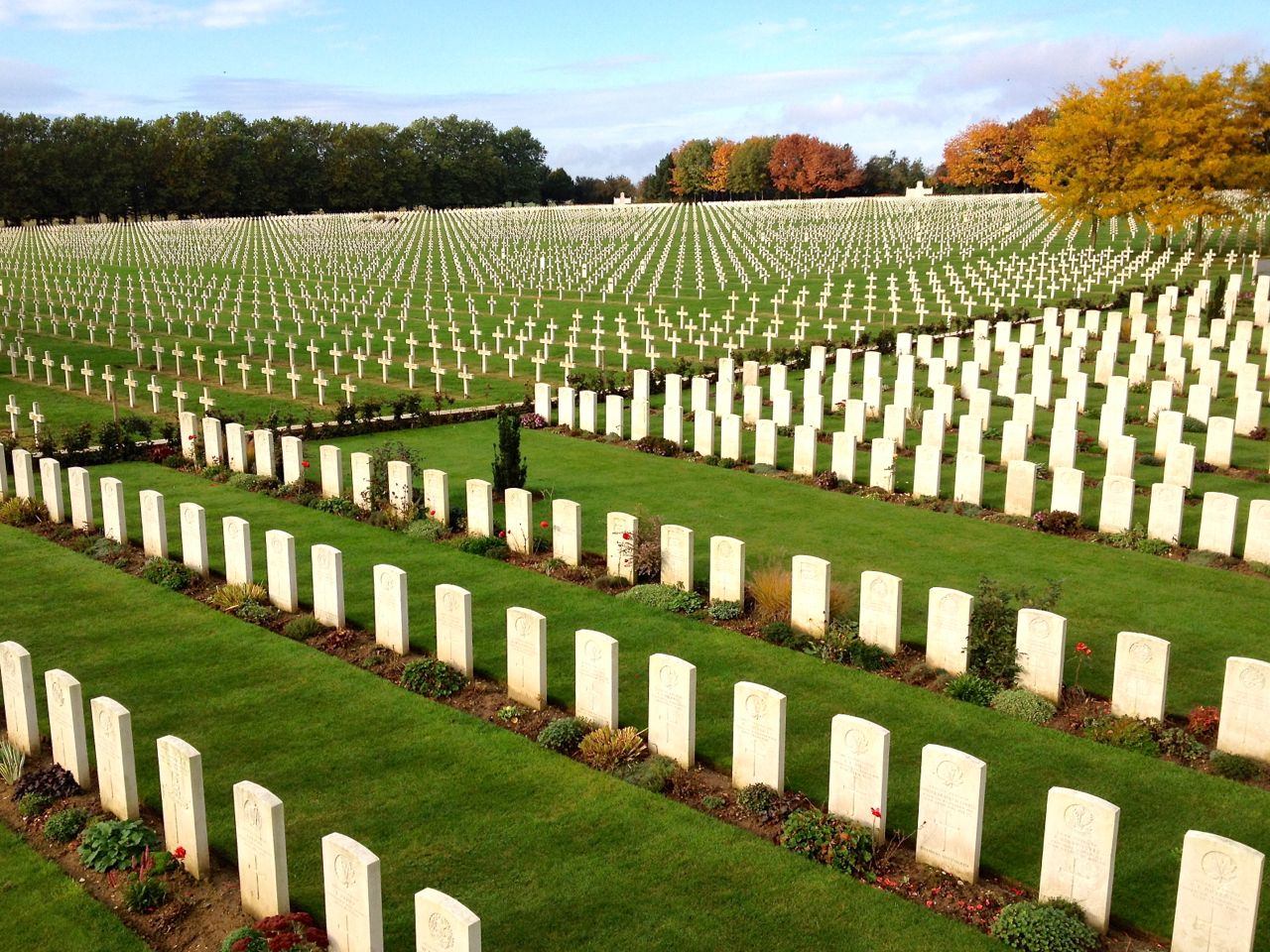
Especially this year, today is, for me, a solemn day for remembering the dead. I am staggered nearly to silence by the loss the war inflicted. The rough figure is 16 million people killed by the fighting; soldiers and civilians. With another 20 million soldiers wounded. That’s the war itself, not counting the Spanish Flu, the Russian Revolution, or the conflicts which simmered in the former Ottoman Empire into the 1920s. The numbers have a danger of becoming simply statistics. I find it more arresting to look at pictures of the graveyards which cover the former battlefields. Solemnly look with me.

What was the meaning of so much death? Famously, the war was supposed to “end all wars”, and that certainly hasn’t proven true in the last 100 years. How much more death have we seen then? Too much. Today, I am remembering all the dead. It’s very hard not to be cynical, but I want to celebrate the idea of peace the armistice of 1918 represents. We can stop fighting wars. We can move things to the negotiation table. We can agree not to kill anyone today. Peace is an idea worth working toward.

To be clear, I am not talking about shaking hands with people in my own country with different politics. That’s too easy. I am not saying there are not things like racial justice and clean water which are worth fighting for. There are! Voices must be raised, demonstrations staged, change demanded. I am talking today about questioning the need for weapons technology and political assumptions which lead to bombing villages from airplanes and building missiles capable of crossing oceans. I am affirming today, on Armistice Day, I want to live in a world without armed conflicts, proxy wars and national posturing in the form of military spending.

I know words matter. A call to memorialize all those killed by war is very different from a call to honor the sacrifice of soldiers. I will let others celebrate today as Veteran’s Day. Today I look beyond the need for military might to appreciate the possibilities of peace.

08 November 2018

Overview: CAPERS by Craig Campbell

Another project I was involved with has reached print. CAPERS is “a super-powered game of gangsters in the Roaring Twenties.” The game first came to my attention almost a year ago when the creator released a preview version to IGDN members. I don’t tend to get too excited about super heroes, but with my head deeply enmeshed in the 1920s and the whole interwar period because of Wild Skies, I decided to see what someone else had done with that time period. All the Jazz Age stuff seemed pretty accurate. Good. Like AMP: Year One before it, I found CAPERS isn’t about super heroes in the comic book sense at all, but about super-powered people. I can get onboard with that. Then reading through the rules, I was fully convinced by the mechanisms. The game uses playing cards for resolution. I ran the sample adventure for my game group. I backed the project on Kickstarter. I met the creator at a convention; turns out he’s a great guy. To cement my involvement with the game, I ended up writing a small amount of content for the game. I even wrote my own adventure and ran it for a local open gaming event. CAPERS is a game that has convinced me to play along at every step. Now that the book is out, I want to talk about it.

The CAPERS book is 163 full-color pages packed with theme. Craig, (I’ll just go ahead and call the designer Craig because we’ve become friendly since we met in person) has done a great job to hit all the notes right to immerse players in that past age. The use of cards for resolution, the appearance of poker chips on the character sheets, Art Deco stylings throughout the book, and choice of a few key game terms like Moxie (a currency players expend to push situations in their favor), to a glossary of ‘20s slang all conspire to put players in the world of the setting. Put on some jazz music, play on a felt topped table and you are there. The book itself is well-printed and there are a ton of extras – don’t have any in hand myself yet, but CAPERS themed playing cards, Moxie cards, maps, GM screen, and adventures are all available. Lots of stuff for you if you like physical bits at your table.

I want to talk about the art quickly. It is all by Beth Varni. She has done a good job with the period look. Full color means all the art is digitally painted so it all pops on the page. Something I also appreciate is the choice to display counterfactual diversity. Not that there weren’t women and African Americans in the U.S. in the 1920s, just that they don’t show up in most of the images of the time. Varni’s art shows people of all sorts doing all sorts of things. Black casino owners, women with tommy guns, female Federal agents, Hispanic and Asian names and faces… It’s great to see this kind of inclusion. It isn’t just the art, either. Gender and ethnic diversity is built into all the NPCs. Well done, NerdBurger.

At the center of gameplay is a straightforward card-based mechanism. The Game Master sets a Target Score for whatever Checks players attempt (average is 8). The player then draws from their personal deck of standard playing cards trying to draw a card which meets or exceeds the TS. Jack-Ace serve as 11-14. Players may draw a number of cards equal to the applicable Trait. For example, if a character with 3 Agility wants to do a backflip (TS 10), they have three chances (called Card Count) to draw a card which is ten or higher, with the ability to stay at any time. A lot of nuance comes into the system around this core card draw system. Skills and spending Moxie add to Card Count, the suit of the card the player stays on can add a Boon or Complication, jokers are either very good or very bad, plus a few other things. In practice I have found a lot of tension comes in when a player is looking at a success with a Complication and wondering if they should draw again knowing they could just a likely draw a success with a Boon or end up with a total failure. It is a great system, which is both easy to learn and fast-playing at the table. I believe Craig even put the rule set out under a creative commons license as CAPERS CORE, so it’s out there for anyone to use.

The other things in the game are a primer on 1920s culture and bootlegging gangs, a section of powers (which work the same as other Checks) with 25 minor and 15 major powers which includes Cold Beam, Flight, Goo Generation, Probability Manipulation, Super Strength and Weather Manipulation, extensive setting information for gangster hot spots like Atlantic City, Chicago and New York City; with ten other cities profiled as well (my contribution was to write four of these cities, including my current hometown of Louisville, KY), some ideas for playing in alternate worlds like Capek’s Earth, the Flipside and Omega Earth, plus extensive indexes so you can find just about whatever you are looking for. It’s a great book, very well-produced, and it’s a great game. I recommend it to anyone who likes either the 1920s or super-powers and to anyone looking for a lighter to middle-weight game (similar to Savage Worlds in complexity) which offers a pleasing alternative to dice-based systems.

If CAPERS doesn’t seem like your thing, NerdBurger is raising funds now for a GM-less horror-comedy game called Die Laughing in which players create a very bad and very deadly horror movie. Check that out too.

03 October 2018

A Review: Lacuna by Jared Sorensen

Lacuna Part I. The Creation of the Mystery and the Girl from Blue City is an experimental roleplaying game...and you’re part of the experiment, whether you realize it or not.


This is how Lacuna begins and the “experimental” nature of the game is soon born out by everything from the character sheets to the page layout. It is the strangest role playing game I have yet come across. Not only is the setting bizarre and deliberately obscure, the production of the book compliments this with blacked out lines of text and double printing which gets worse as the book goes on. I have seen other game books present themselves as if they are agent handbooks from within the setting, but this one really captures the confusion and bewilderment which the setting also conveys.

More about the setting, but not too much because it’s in part about that secret of the Lacuna. There is a lot to say about the setting – but I don’t want to say too much because the game is set up to progressively discover the setting through play. I often think of movies when I think of role playing settings and this one strikes me as sharing elements with The Matrix, Men in Black and Inception. The player characters are agents who use drugs and dreaming to enter the strange world of Blue City where they chase down Hostile Personalities and banish them to the Lacuna with the assistance of their tenuous connection to Control. The City is seemingly infinite, always night, and full of Personalities who go about their business; appearing and disappearing as in fog. I feel playing into all the obvious noir elements of the setting is best.

In addition to the setting, I am also intrigued by the mechanisms of Lacuna. The central resolution mechanism is rolling D6 equal to attributes, usually two to four, hoping to roll eleven or more. After every roll, succeed or fail, the result is added to your character’s heart’s Beats Per Minute. Characters enter Blue City with their PBM at their Resting Heart Rate. After a few rolls, BPM gets up to Target Heart Rate and while in the target range, you can roll as many D6 as you want. As many as you want. This almost guarantees success on your roll, but your result still adds to your BPM. Once you push yourself beyond your Maximum Heart Rate, failing a roll will cause damage in the form of reduced attributes.

I have only played Lacuna in the form of a one shot. I’m not sure how all the mystery and the feeling of bewilderment would be sustained over a longer term. It would be a challenge for the GM to deal out the secrets slowly and for the players to acclimate to each new threshold of discovery. There’s plenty of stuff this brief review doesn’t mention just because I want you to discover it all for yourself. Reading the game is an experience in itself so it’s worth reading even if you never play it. It is fun to play, though, so I highly recommended you play it. Lacuna is a unique game and very affordable; get it and read it and try out this experiment in role playing for yourself.

29 August 2018

Liberating Edits

All month long I have been doing some heavy lifting to get our document for Wild Skies: Liberating Strife ready to send to our editor. As much as getting the first book turned around required growing pains, this follow up almost seems to involve more. My writing partner and I had never put together a book by ourselves before. Now, even though we have done that, we have never put together a book from other people’s writing before. There are five total writers for this book and getting everyone’s pieces in hand and stitched together took more work than I expected. Also working with an editor is new to me. Growing pains.

Thankfully, my work is now complete enough that I can shift the project to someone else for a while. I am looking forward a few lighter weeks. There are, of course, a few more pieces to actually write and we don’t have all the final art in yet. Then we have to look at the edits and apply the advice. There is still a good bit of runway before this thing takes off, but we are moving forward. There will be a lot of good information and really nice hooks to hang adventures on when this book is finally done. Keep up with all the updates here.
Yellowstone National Park - art by Steven Woo

14 August 2018

A Review: The Extraordinary Adventures of Baron Munchausen by James Wallis

Portrait of Baron Munchausen
Tell us, Baron, the story of...
...How you circumnavigated the world without leaving your house.
...How a portrait of Henry VIII saved you from being attacked by lions.
...Why every fifth child born in Brussels is named after you.
...How you became the first man to descend Mount Blanc, before any man had climbed it.

This is certainly not a traditional roleplaying game. In fact, I would say it is barely a roleplaying game at all. Yet, Baron Munchausen is one of the most enjoyable roleplaying game books I have ever read. In this “paperless” age of digital game books, I plan to add the “dead tree format” of this book to my shelf.

At its core, it is a very simple game. It is really a story-telling activity in which players interrupt each other to comic result. Less briefly; players take the role of nobility, telling of their adventures at a tavern or house party. The character creation process is limited to developing a noble name and title. The process of play is for four or more players to take a turn telling a five-minute story of their own entirely truthful adventures during the Eighteenth Century. Each tale must attempt to out-do the previous tale and begins with a prompt like those given above, asked by the nobleperson on the teller’s left. Both the game and the roleplay aspects come in during each tale as each player has a purse of tokens equal to the number of total players. Each player is allowed to interrupt each teller once by offering them a token and asking for clarification about an element of the tale, pointing out an inconsistency, asserting the story may have happened differently, or otherwise trying to trip up the storyteller with comic or challenging suggestions. The current tale-teller may simply accept the token and the addition and work this new detail into their tale; or they may add their own coin to the stake and offer an insult to the interrupter to put them in their place. Likewise, the interrupter may take the stake and accept their rebuke; or add a third coin to the stake, offer their own insult and insist the teller acknowledge their original suggestion. This back-and-forth may continue until one player exhausts their purse and must admit their error. If they are still unwilling, a duel may be initiated (decided by best of three rounds of rock-paper-scissor) with the loser forced to submit and take the stake. If, during the insults and raising, either insults the other’s noble rank, proud parentage or outright calls them a liar, a duel may begin immediately. When each tale concludes the teller prompts the player on their right to tell the next tale. When all tales have been told, players each pass their entire purse (converting it to a bounty) to the person whose tale was the most extraordinary. Thus the winner of round is the player with the largest bounty, and now being flush with cash as well as honor, is compelled to “buy the next round” and offers the prompt for the first tale of the next round.

In the book, these rules are summarized in two pages and there are eight pages of sample prompts. However, what makes the book a joy is the comic style in which it is written. James Wallis, who is a veteran game designer, has channelled the spirit of the original Baron Munchausen material. It is presented as a dictation by the Baron himself to various members of the Wallis family line and as such is filled with the Baron’s own stories of himself, his opinions, and numerous digressions from the through line of actually explaining the game. The book also presents a number of variations on the game, from one in which interrupting means the interrupter becomes the teller with the object being to be the first actually finish your story, to a variation for younger players, to a whole list of suggested genre implementations of the game such as cavemen, vampires and supervillains.

I have played this game twice and as is true of anything dependent on social interactions it flows better if players are willing to submit to the premise of the game. Those with better comic timing, more inventive or quick-thinking minds and larger vocabularies of “old timey” words will be more likely to tell the most extraordinary stories, but it is not a guarantee of success. It seems the best moments come out of the unexpected way a teller incorporates their interaction with the interrupter. In one game the winner did not know the rest of the players as well and his story took on a hyperbolic nature while the rest of us relied more on our shared history. In the other game the winner had been called a liar, escalated the interruption to a duel, but then lost and so chose to completely capitulate and when back through their story renouncing each aspect and telling how what really happened was far less impressive. This idiosyncratic interpretation of the standard rules was singularly comical and so unexpected it won the round.

The Extraordinary Adventures of Baron Munchausen is not a game for everyone and certainly not for anyone all the time. It is not the sort of game to play a campaign with, or even to play very often. However, as a pallet cleanser between other games or as a one-off event at a game night or convention, this is a great option. Whether you ever play it or not, it is worth a read as a light piece of pseudo-historical comic writing. I enjoyed it very much.

03 August 2018

200 Word RPG Challenge

This summer I made a commitment to play more games with the local RPG scene. There is fortnightly game event called Slur Your Role put on by Nerd Louisville at a bar not far from my house. I have been volunteering to run games there. The event is pretty Dungeons and Dragons focused because that game is so popular (no shade), but I have been trying to bring alternatives to the table. So far I have run CAPERS from NerdBurger Games, Lacuna by Momento Mori Theatricks and a couple weeks ago I ran three of the games from this year’s 200 Word RPG Challenge.

I heard about 200 Word RPG last year and when the competition went live this year, I not only submitted a game, I applied to be a reader. I read about 60 submissions and recommended my favorites to the actual judges. Some of the ones I selected were, indeed, among the finalists. The whole process was enjoyable and being part of it made me feel all the more like I am part of this industry. I wanted to promote the Challenge and bring this brand new games to the table. Titles of the games are links to the 200 Word RPG site. Do go read the games, as they are all only 200 words!

Of the three winners we did not play Sidewalkia! owing to it being a game for outside voices and it being one of the hottest weeks of the year. Instead, we played PSYCHIC CHILDREN ON THE RUN FROM DANGER. This was one of the games I’d read and picked to be a finalist. I liked it because of the resolution mechanism. To use their psychic power players guess the next card which will be drawn from a standard deck of cards. If they are exactly right they have complete control, if they are less right they have less or no control. It worked great with five players at the table watching each other’s card draws and really playing up the theme. One thing I was looking for in the games I selected was the possibility to play the game over several sessions. This one delivered on that idea. No one was ready to stop after an hour, but I had to move on.

For Dear Elizabeth… I brought the required paper, pens and prompts (things like “death,” “courtship,” “visitor”). It’s a two-player game, but we simply paired off writing letters only to our partner. I was least sure about this one. All my players where modern guys in their 30s so playing a young 18th century woman wasn’t exactly what they might have come to a game night for. Once I explained it and handed out the materials and once they were sitting in their corners drawing their prompts and responding to the letters they got from their partners, they all took to it. More than one person said it was much more enjoyable than they thought it would be. When we summarized the letters at the end I was happy no one had brought in aliens or zombies. It was all decidedly 18th century issues.

Our last game of the night was #WinterIntoSpring. It was, I assume, intended to descend into a bit of a mess and take on elements of farce. Maybe not, but that’s what happened for us. The idea is to splint into two factions and roleplay fashion vloggers before and after a revolution with one faction replacing the other as the dominate faction between the two rounds. Magazines are cut up and made into paper dolls to represent the changing fashions. The group decided our factions would be “machine overlord sympathizers and human freedom fighters.” Then I revealed the two magazines I had brought along were a bridal magazine and a fly fishing magazine. Silly mash-ups and hyperbolic descriptions of the fight against the machines ensued. What more could one want?

I’ve loved being the one to bring the not-at-all-D&D to the scene this summer. I think playing games with more strangers has made we a better game master. I certainly feel stretched by the experience. Add to that the additional stretch of putting a few different 200-word games on the table in one night and I feel very pleased my table seemed to enjoy themselves. I plan to participate in the 200 Word RPG Challenge again, and I hope I can also bring next year’s winners to an audience.

23 April 2018

Am I Dieselpunk?

In support of Wild Skies: Liberating Strife, Brandon and I have been recording a few podcast appearances. Most recently we were on The RPG Brewery. Since we’ve called Wild Skies a dieselpunk game, we also appear on the newest episode of The Dieselpunk Podcast. They asked a question they ask of all their guests; “When did you know you were dieselpunk?” My honest answer to the question is: “Only when you told me I was”.

To step back a little bit: while Brandon and I were developing Wild Skies we always said we wanted it to be dieselpunk. The game was always set the 1930s and took inspiration from the ’20s and ’40s as well. To us, it was about staying in the technological brackets of “after airplanes” and “before jets”. The “punk” comes in with the idea “all problems can be solved by adding a bigger engine”. With these ideas set, I don’t feel we had to work that hard to make our game dieselpunk. We looked to the political, cultural and technological elements of those decades for our inspiration and naturally remixed them as we saw fit.

John and Eric of the Dieselpunk Podcast use the definition “retro futurism of the 1920s through the 1950s” when they talk about what dieselpunk is to them. I first encountered that definition last fall when John interviewed Brandon about the release of Wild Skies: Europa Tempest. By that definition, some of my favorite pop culture is dieselpunk even though I never called it that before: The Rocketeer, Batman: The Animated Series, Dark City and Nausicaä Princess of the Valley of the Wind. If I push the definition a little more to include what was actually produced in the ’20s-’50s, virtually all of my favorites are dieselpunk: Dashiell Hammett, H.P. Lovecraft, noir films like A Touch of Evil and the aesthetics of Soviet propaganda posters. I’m dieselpunk. Who knew?

Being on the show was great. I listen to a bunch of podcasts, but that was only the second time I have been on one. Brandon and I know what we like about our Wild Skies setting and about role playing while our hosts know about trends in dieselpunk, but almost nothing about role playing games. There was a lot of room for us all to learn from each other.

One idea mentioned in passing on the show which I want to weigh in on is the question: is dieselpunk about the particular technology or about the aesthetics of a setting? For me it’s all about the aesthetics and the attitude of remix culture. It’s what I call the blender. It what you put in the blender comes from the dieselpunk era, what you get out of the blender is dieselpunk. As with steampunk and cyberpunk “genres” before it, so much more fits under the umbrella of the name than just the technology of the time in question.

I have an important point about this. The remix is needed because the pop culture of so much of the past was so one dimensional; that is, white male heroes. For me, remixing the past in a “punk” way allows women, people of color, homosexuals and anyone else who tended not to be in focus, or allowed to be heroic of escape from stereotypes to become the center of action on their own terms. Again, steampunk led the way and it’s one of the things I appreciate about it.

I think dieselpunk – at least what I want it to be – should do the same thing. As a creator I need to open up the playing field so anyone can have adventures in the textures of this period. We’ve tried to make the right steps with Wild Skies: Europa Tempest. We present women in our NPC crew and in leadership positions. Our supplements include gender non-conforming and gay characters as well. As we assemble Liberating Strife, I realize there is still room to grow as my own awareness of the importance of representation grows. As a person who can so easily see myself in the pop culture I love, I feel an extra pressure to present my remix in a way where other people can see themselves as well.

27 March 2018

“O beautiful for heroes proved in liberating strife...”

Today is the start of the crowd funding period for the first source book for Wild Skies, the premier anthropomorphic diesel punk role playing game. This time we are turning our attention from post-war Europe to North America and the Roaring Twenties of the United States in particular. Taking a line from the song “America the Beautiful”, the title of this source book is Wild Skies: Liberating Strife. The project is live on KickStarter now, so please go there to support the book and help make it a reality.

From the beginning, my writing and business partner, Brandon, and I envisioned Wild Skies as a game to explore the many aspects of pulp-era adventure. This is the first of several planned source books. We wanted to begin with Europe because it is something less often seen, but we always knew an America book would follow. Almost as soon as the first book was announced, we were asked by fans, “So, when is the America book coming?” Knowing everyone considers a source book for America an obvious choice, we expect the project to generate a lot of interest. We will be delivering new animal types, new careers, new perks and quirks; all with an American theme. Keeping with the diesel punk feel we established in Europa Tempest, the America setting has flying battleships and dogfights and cities full of big machines. In contrast to Europe, we have asked for more Art Deco-inspired design in the aircraft and buildings. Inspired by the “current wars” and the early electrification of New York City, we have made electricity a central part of the story but ramped everything up to the point nearly limitless power is distributed wirelessly to everyone.

Beyond the technology, the other huge conceit of the setting is the “trust busting” efforts of Theodore Roosevelt didn’t really stick, nor did the stock market crash of 1929 happen. We posit a situation where all large corporations were instead consolidated into one mega-corporation owned by the Dennington family. Unlike the political tensions we explored in Europa Tempest, we aim to explore economic tensions with the story hooks of this book. What would it look like if a company really acted on the idea “a happy worker is a productive worker?” How do different people make lives for themselves in a ruthlessly capitalistic meritocracy? What other interpretations of “the American dream” are possible?” We also want to explore the international implications of the United States’ isolationist stance.

We had some growing pains over the course of our first project (Customs form? What is that?), but we also learned more about how to do the kinds of projects we want to do in this industry. We are experiencing the Dunning-Kruger effect, for sure; realizing now how little we knew before. Though we expect Liberating Strife to be a smaller book then Europa Tempest, we have more help lined up this time. There are four primary writers instead of just two and we have a whole team of people in place to write the stretch goals when, if and as we reach them. We are expecting a quick turn-around on this project and delivery by this year’s GenCon in August. I’m never sure what it should feel like when I’ve “arrived” in the industry, but I think once this project gets funded and we have two full books out in the world as Wet Ink Games, I will feel more like I have made it.

Come fly the Wild Skies with us. This time over America!

06 December 2017

Culminations which are but Preludes

The first downloadable supplements for Wild Skies: Europa Tempest are now available! These were paid for by stretch goals and certain backer levels during the our Kickstarter campaign two years ago. Right now we have an adventure called Lucky Rabbits Afoot, featuring raiding rabbits from the Saar Warren and a closer look at the small nation of Luxembourg. We are also offering a mercenary crew profile of the Rock Roost Renegades which includes four full characters from Corsica and a few of their unique technical innovations. These are just the first of several small releases we have in the works.

I have been working to fulfill my part of these extras for a while. It’s been a real learning experience, as cliched as that is to say. The “Luxembourg adventure” I wrote was inspired by a campaign I ran during the very early days of Wild Skies when when it was a setting grafted onto a different set of rules. As part of the process I got to (and had to) pick an artist, correspond with that artist, send art reference, have my work reviewed and all the rest. I have only written one previous adventure, so I’m still not sure exactly what I need to do. To make things worse, this is the first adventure for the Compass System so there are no models to follow. Again, I get to (and have to) make all the decisions about format and length and how to boil down the NPC combat stats for GMs without leaving anything out. Maybe it just feels trickier than it is because I am my own worst critic. Now that it is out, it can see what a lot of other people have to say and make changes for next time.

The mercenary faction was a special personal project for me. Not only did all the same “learning curve” stuff about art and setting format precedents apply, but I got to work with my father to create the faction. As a backer at a certain level, he got to create this faction and all the characters. My father is not a roleplayer at all so he didn’t really have a desire to pick skills and assign attributes. He is a story teller and the depth he went to in creating back stories for his team of ex-military freedom fighting bats from Corsica is inspiring. He started with the facts of the Corsican biota and chose his characters and the nature of their fighting techniques from there. He wrote character bios and a short story about the origins of the team which I then turned into the game’s numbers and skills list. This was not what I expected when we offered “we will work with you to create a mercenary crew” as the Commodore backer level, but it ended up being very nice to collaborate with my father on this project.

Wet Ink Games has more products to release and more games in the works, so keep watching the skies for more!

13 July 2017

The Launch of Something

Wild Skies: Europa Tempest is for sale! It has been almost two years since the KickStarter, over three since I started work on my parts of the rules system and something like seven years since Brandon and I first cooked up the setting. We have PDF copies for download right now. We are getting the proofs of the hardcopy version and there will be both hardcover and softcover copies available soon.

There are a lot of reasons to be happy about reaching this point. First off, I have to say, the book looks great! I keep saying it looks like a “real” game book. We made a role playing game! I give a lot of credit to Knox, who did all the layout work. He took it upon himself to make the flavor texts I wrote look like the type of document they are supposed to look like. He played with fonts and layouts to make advertisements, medical reports and letters look like pieces of ephemera from the world and not just descriptions of this fictional world. The art is another big part of the success of this product. To work with so many talented artists and get such good pieces to illustrate the concepts and rules adds more than I can tell to the overall impression we have managed to put together a real product.

This first product for Wet Ink Games has been a non-stop education process for myself and Brandon. I’ve written manuscripts before, and seen my words published by game companies in the past. This is, in fact, the third book-length project I have written with Brandon. All the editing work was stuff we were used to, even if there was more to do this time around. Beyond that it was all unknown paths for me. Before now, my part was only to get the words on the page. I’ve never had to (maybe I should say “gotten to”) work with artists before. I didn’t have to think about layout. There was no process of back and forth about column length and where information appeared on a page. I didn’t have to pay attention to details like whether a title was underlined or bold. That was always someone else’s job. Putting the Europa Tempest book out there means we have overcome all the challenges we didn’t know we would have when we decided to do this book. I know it’s an achievement.

I hesitate to add a “but” to this post, but there is a “but.” Firstly, this Wild Skies project has been a big effort and has taken up so much of the background (and sometimes the foreground) of my life for years. I know getting this far is not the end; it’s just one step in the process. We aren’t finished with this first book until the hard copies are out. The KickStarter isn’t fulfilled until be do a couple more supplements, which are already in process. Then there’s the promotion events we have lined up. Provided all this goes well, we have plans for the next book in the Wild Skies game line and plenty of ideas for more books after that. This no time to stop and celebrate. There is no end, nothing ever ends. Secondly, and I want to be brief about this one, there is something very melancholy for me about seeing all the work of the last three years boiled down to a link and a price tag. I’m not sure I understand my own feelings on this, but there it is.

To bring the mood back up, let me once again say, Wild Skies: Europa Tempest is for sale now! Pick it up from DriveThruRPG.
Follow the project on KickStarter.

10 August 2016

A Writer Levels Up

Things are moving along nicely with Wild Skies: Europa Tempest. The manuscript is closing in on 200 pages. There are some parts which remain unfinished, but I have been doing some of the fill-in work on the smaller sections. I wrote a “What is role-playing?” bit yesterday for the very few people who would be interesting in an RPG book but who don't know how to play one. After all, new gamers born every day. I also spent some time researching historic prices on gold and silver. In an alternate history setting, we could say the prices are whatever we want, but I wanted to base my made up numbers on something.

I have also been accepted into the Indie Game Developers Network. It's something of a little tiny trade organization for independent game developers. My mug is up on the members page, so I seems like it's for real. I look forward to working with all these fine people to promote the games industry.

26 May 2016

Wild Skies Character Primer Updated

As I discussed previously, Wild Skies: Europa Tempest has been my major on-going project for almost a year now. Brandon and I are happy to show off some of the progress we have made on the project. The Character Primer 1.2 is now available! The document contains everything needed to create a Wild Skies character; information about the nine attributes, all forty animal types and dozens of animal abilities, twenty career choices, rules for the Moral Compass and ten different party affiliations. This is not the complete game. Histories of various nations, vehicles, equipment, combat mechanics and full skill descriptions are not included. Still, the Primer should provide a taste of the theme and the kind of game we are making. Do have a look if you are at all interested in an alternate history, anthropomorphic, diesel-punk, pulp adventure role-playing game. If you still want to get in on the creation of this game, contact us. Keep watching the horizon, because more is on the way. Thanks.

13 May 2016

Crafting Alternate History

El 114 de infantería, en París, el 14 de julio de 1917, León Gimpel Since our Kickstarter for Wild Skies: Europa Tempest was successful back in October last year, Brandon and I have been working on the book. Most of the rules have been at last ironed out (more on that in time) and it is time to turn back to our setting and get it all fleshed out. That is what I have been mainly working on for the last two weeks. It has been great! I love crafting alternate history. From the beginning our jumping-off point was always, “What if the First World War never ended?” With that as the basis it's been my job to turn that core idea into a description of the dozen or so years since the 11 November 1918 date we are familiar with from real history.

We are well aware we are not the first to offer an answer to the question, “What if the First World War never ended?” Harry Turtledove, Michael Moorcock and the makers of Tannhäuser, among many others, have all been over this terrain before. Throughout these last two weeks, I have been thinking a lot about one of my literary heroes; Lawrence Watt-Evans. He once wrote he's never been into writing historical fiction because he's always troubled by the why. Why that particular divergence point in human history? Why that particular version of events from the infinitely many possible versions? My answer can only be; we wanted to create something broadly familiar, but unlike other story worlds we have seen before. We started with a few assumptions about our setting. The first being the on-going war led to revolutions in all the major participants. From there, we assume Bolsheviks would not win the revolution in Russia (at least not outright) and fascists would win a revolution in France. We didn't want Germany to be the Third Reich ten years ahead of time. We did want Britain to lean Orwellian. The United States never entered the Great War.

Excepting those basic assumptions I have been digging through histories of the era and looking at events which followed the Armistice to find little incidents and factoids both to justify and to inform our setting. In our previous projects Brandon and I have both taken echoes of real cultural fragments and recast them in new ways within our fictional settings. Working backward through the list above we take the pro-Wilson 1916 campaign slogan, “He kept us out of war,” and just say he did. Not even the sinking of Lusitania brought American troops to Europe, thus everything which follows is different. We have a lot of ideas for America, but they will not be the focus of Europa Tempest.

The countries of Europe have been our biggest focus. As I said, I'm very happy with the way things have come together. Churchill, famous for his role in WWII, was also in the government during WWI. He fell from power over how the war had been fought. Now take that to the extreme. If the whole government of 1918 is replaced because no one in the country is happy about how the war has turned out you become able to posit the kind of drastic changes Orwell envisioned thirty years early. With Germany we have focused more on a return to pre-war war fever than moving forward to the Nazi bugbear. Kaiser Wilhelm II left at the end of the War. In our setting he has returned to power as an bit of an older and wiser figure. He's not as eager for war in our 1930s setting as he was in 1914. He's the voice of reason now trying to keep in line the newer generation eager for war. It's this reuse in a different form of all the part of history you may have heard of that really gets us excited as creators.

Our inspiration for our other main countries comes less from inversions of specific people and more from ideologies. The basic inspiration for a fascist France comes right out of the Second World War period. I read a few books looking at the tensions within the Third Republic and the origins of the Vichy regime. To make the story very short, the same kind of militant nationalism which became fascism in Italy and Nazism in Germany existed in France as well. It is not hard to imagine a cadre of young fascists forming in France during the war and not much harder to imagine an opportunity for them to seize power in the aftermath of the war. Speaking of cadres seizing power, in Russia we have declared the civil war following the October Revolution is still on-going even into the 1930s. Reds and Whites and many other factions are still trying to work out who will win. Our vision of Russia is perhaps the least possible because we haven't pushed anything which helped the Whites or which hurt the Reds. We just want it this way.

I haven't explained much about the setting, I know. This was only supposed to be the briefest mention of some of the bits of the story I've been working on recently. If anything mentioned here does interest you, please have a look at the Kickstarter page. This project is funded and moving along and you can still jump on by contacting us there. Until next time.

08 March 2016

AMPed Up!

Another project of mine has come to fruition. Third Eye Games has just published United Human Front: Affiliation Guide for AMP Year Two for its AMP: Year One game line. In the game, AMP stands for Accelerated Mutant Potential. When the game first came out I wasn't too interested because I'm not a huge superhero fan. I miss-understood things. AMP is not a superhero game, it's a super-powers game. Maybe it's not that big a difference, but it's an important one. AMP has plenty of “faster than a speeding bullet” without a lot of spandex costumes. When Eloy asked me to write for the game and I actually read the book I liked how dark it was. AMP is full of 1990s-era Marvel-style angst; “they hate us, yet we are dedicated to saving them from themselves.” It's also full of government distrust, secret machinations and downright nastiness which seem to have been pulled from the headlines of recent years. A good setting for a game.

I was asked to write a guidebook for members of the United Human Front. These are the people doing the hating of the AMPs. Explicitly. At first I was not excited. No one wants to be stuck writing about the one-dimensional “bad guys.” Well, I didn't anyway. I took it as a writing challenge, how can I make the anti-mutant faction in a mutation-based super-powers game into something which seems positive? How can I make the UHF a viable option for players picking their character's affiliation? How can I make this faction into something more than a stereotype?

I decided to focus on two things. Conspiracy theories and the kind of anti-government domestic terrorism America saw in the 1990s. McVeigh, Kaczynski, Koresh; they all came from within American culture. That part of the culture hasn't gone away, either. There are even more conspiracies afoot than ever these days. I tried to present the UHF members as thinking people (maybe thinking too much). They have looked at all the evidence and come to their own conclusions. Two members don't have to agree on what AMPs really are, or who created them in the first place to agree they are a potential threat to decent folk everywhere. AMPs are people who can turn into fire or smash rocks with their hands and who are drawn to fight with each other whenever they meet. That's dangerous! The United Human Front is circling the wagons and defending what they know. It's a noble position, in a way. I've also put out the idea not everyone who looks down their nose at an AMP is actually a member of the official UHF organization. This lets GMs use human antagonists claiming UHF affiliation who aren't actually acting by the more careful and deliberate means of the UHF hierarchy. Since the game establishes the UHF was founded by a geneticist, I played up that element too. The UHF top tier people know AMPs are different on a genetic level. It's not technically wrong to say they aren't human. Maybe the man on the street uses it as a cover for racism and fearmongering, but not all members of UHF take the same lessons from the founder's genetic tests.

I've tried to weave the idea of conflicting views of reality into the adventure which forms part of the Affiliation Guide. I have crafted stories as a GM for my weekly game group and I tried to write part of a choose-your-own adventure one time, so I didn't think an RPG adventure would be hard to write. I was wrong. I've not written an RPG adventure for publication before and I found it difficult to present a story where the players were forced to question their own definitions of human and mutant. My first attempt was roughly twice as long as it was supposed to be! I had trouble creating characters players were supposed to care about. I had trouble accounting for everything a group of players might do. I wanted to have multiple paths so different UHF groups with different visions of what it means to be “defenders of humanity” could enjoy the adventure. Ultimately a lot of the branching pathways had to come out to bring the thing down to size. The manuscript I delivered has been polished to a nice gleam by Eloy and the rest of his team. It can only improve when the creators of the game give it a once-over, right? I love seeing ideas I labored on over my keyboard turn into pages with proper layouts and illustrations. Well done, Third Eye Games!

If you want to check it out, the United Human Front Affiliation Guide is available now.
If you want to get started with the AMP game, check out AMP: Year One.
You can also back the Kickstarter for the latest book in the series; AMP: Year Three.

04 November 2015

Off to a Good Start

First of all, I want to point out the Kickstarter we've been running has ended with great success! We ended with 139% of our goal raised. Thank you to all our backers! This is a great showing for a first-time company. We'll have the comic, custom dice, two bonus adventures and forty different animals because of the stretch goals we reached. I'll be posting about this project here throughout the year as Brandon and I get everything written and tested and ready to go, but you can follow along on the updates page as well.

The timing has worked out great. Just as the Kickstarted ended on 31 October, NaNoWriMo began on 1 November. I am very happy with the progress so far. Having a good idea has been a great help. I've chugged along to a little over the minimum word count each day so far. I'm not over my count for the day yet today, but the day is far from over. I say I had a plan, but that isn't really true. I had no idea what the plot of the story was going to be beyond the vaguest rise and fall of the action. The only think I was clear on was the journal format. That has been going well. I've always loved the books where part of the story was in the “extra” information on the page. Information hidden in the footnotes or encoded in the dates of diary entries has always appealed to me. I am getting to do that here. Somehow it's great fun to skip three days in the dates and come back in with my protagonist making an oblique reference to what else he has been up to. That is where my plot is slowly building up. It's like Shakespeare, a little, where all the action happens off stage and you just have the characters talking about how they feel about the action in soliloquy.

Not that I'm writing Shakespeare, but I am tying to affect an “old-timey” style. My story is supposed to take place in 1648. I don't know if I have an accurate “old-timey” vocabulary for that year. In fact, I would say I don't. My word choice is much more Nineteenth Century, I'm sure. I can't actually think of anything I have read from the Seventeenth Century other than the King James Version of the Bible. The great thing about NaNoWriMo, though, is that getting it “right” doesn't much matter on the first pass. If it sounds old, it'll read as “old.” I can always go back and fix it to the right kind of old if I develop the novel beyond the writing of it this month!

Here's a taste:
I have re-read again the passage from Goloksh. So convenient to have it written out so near at had. Again, I am drawn to de Chapallon's straight-forward amateur's method of simply asking the crystal whence its power derives. The practiced magus often shies away from direct confrontations with power because he has come to know their hazards. I suspect the first small text I transcribed under its influence is the same text he records. With Goloksh I pine for the proof of this theory by the actual page itself! On what misapplied hearth did that great artifact go up in the halls of Savoy? Alas. As I say, I believe I have begun as he did and this text we both produced is the answer to the question he posed. In short it is the proper appellation of the power to which the medium of this black stone opens the way.

Right now my word count is 6700 words.
By now I should have 6668 words.

22 October 2015

Fully Funded

Big, big news! The Kickstarter for Wild Skies: Europa Tempest has reached its initial goal of $8,000! As of now the project is go. Thank you to everyone who has supported us so far! From this point on, everything else pledged in going toward the stretch goals. That's the cool extra stuff we want to add. Let me be clear, when Brandon and I planned this out beforehand we decided the initial funding level would allow us to the make the game we want to make, with all the art and world information needed to understand the game. The stretch goals are just that; stretches, extras, icing on the already delicious cake.

The first stretch goal is a bonus adventure written by Brandon, and the second is a short comic set in the Wild Skies world by accomplished industry artist Mike Mumah. Mumah played in the sessions where Wild Skies was first developed so he knows the setting. I would be surprised if his character does not feature prominently. Ever seen a giant sheep leap out of a flaming airship falling into the sea? You won't unless we reach that stretch goal. Then more factions, more adventures, even custom diesel punk-themed dice. My point is these are not “make the book complete” stretch goals, these are truly bonuses which will only increase the fun and awesome factors of this project. If you haven't put your two cents toward the project yet, there's never been a better time.

If you want to read more about the game, there is a growing list of updates on the Kickstarter page where we have dished out a lot of information about the setting and the game mechanics. If you want to read even more after that, you can read the chat log from last week when Brandon and I were guests of #rpgnet for an old school IRC Q+A. Really!

12 October 2015

Wild Skies: Europa Tempest Raising Funds Now

It's been a while. I haven't been idle, though. This has been a very busy year for writing so far. I have been working on a lot of projects at once in rather piecemeal fashion. I've had a couple writing projects on at any one time and I've also been doing a lot of research for ongoing and future projects. I aim to work through discussing all the things I've been up to over the next couple weeks.

The biggest thing in my writer's life right now is my long-time writing partner and I have decided to launch our own role-playing game company, write our own game system and start our own game line! This is huge news for me. We don't exactly aim to become market leaders, and we know it's a crowded market, but I think we have something no one else it offering. If you want all the details, quit reading this and head over to Kickstarter right now and check out Wild Skies: Europa Tempest. If you are like me and you want to know what you are going to find before you follow a link, I'll describe the project.

This has been a project long in development. Brandon, my friend, writing buddy, brother-in-law and all-around fellow nerd, cooked the basics of the setting up a few years ago. We wanted to play a certain anthropomorphic animals game, but the setting didn't quite suit us. We developed a new setting for that game's rules. We imaged a world where the First World War didn't end in an armistice, but in civil wars in all the combatants. The 1920s were complete chaos across Europe. Our game is set in the 1930s when things are more stable, but borders and governments are very different. I started with a map of every division line Europe has experienced in the Twentieth Century and starting filling in new country names. Brandon wanted “diesel punk” so big engines and well-muscled mechanics feature prominently. We've put in flying airships as well for a hyper-reality one of our friends called “historical steroids.” The fact that everyone is an animal allowed for so many animal jokes. One of our mantras for playing the game was never let the opportunity for a good animal joke pass. I don't know about other people but we love pirates who are rats, elephant security guards who never forget and a rhino and a tick bird who work together as an assassin team.

After playing several adventures in this setting, we moved on to other games, but we began to develop a set of our own rules to use with our new setting. Unlike some other rpg-systems, our game isn't focused on “winning” by dealing the most damage or earning the most XP. We've put the storytelling first and foremost. Our experience system rewards players for advancing the story lines they choose for their characters. We call this mechanic the Moral Compass. Character creation is point-buy for stats, two careers are chosen which determine the character's skills. The rolls in the game are percentile (D100) but skills are buffed by additional six-sided dice called Skill Dice. The more training, the more dice, the better chance a character can ensure a favorable result on the role. There are 30 animal types to choose from each with a unique mix of animal abilities. So, now that you know more about it, follow the link to get all the details and see some of the art we've already commissioned from the game. Help make Wild Skies: Europa Tempest a reality. You have our thanks.
A boar, lynx and bulldog defend themselves from a horde of barbarian rabbits.

08 March 2014

A Brief History of Recent Times


I have been a busy, busy guy in the last few months. I don't feel there has been time to post. I have no idea how I had time to post almost daily during NaNoWriMo and still get my stuff done. No idea.

You may remember I mentioned other projects in the background during my November posts. Let me give a rundown of what I have been up to. I submitted a manuscript to Third Eye Games in August for the game Part-Time Gods. It's a role-playing game where everyone plays the role of modern-day gods trying to balance their divine duties with the human side of their lives. They are only part-time gods. The power that is over at Third Eye Games liked it well enough to ask me to write more in the same game line. I submitted the first draft for that on 7 November. Then for a couple weeks I just focused on my NaNoWriMo.

However, I had also been working on a very long term project with another guy for Palladium Books. He declared (and I agreed) after four years of working on it on and off, 2013 was the year to finish. I realized along about 22 November there was no way I could wait until 1 December to get back to the Palladium project. At about the same time the edits came back for my Third Eye Games draft. That's three projects that needed work ASAP!

I worked on The Valley of Insects as a warm-up or cool-down activity but I considered finishing my Palladium manuscript my first priority. I was still working on my NaNoWriMo on 30 November, putting in a little bit more here and a little bit more there. I got just over the mark. I'm a NaNoWriMo winner! There was no stopping, though, I finishing my writing for the Palladium project on 4 December. Next I re-read the whole manuscript, both my sections and the sections my co-author had written. It was very helpful to see the whole project at once for the first time. It's the book we wanted to write (good thing, right?). There was a little bit of adjusting we needed to get the tone consistent throughout. My co-author and I met throughout the second half of December to hash out how to clean up problem issues and who was going to tackle what. I am very happy to say we completed all our work on 31 December at 14:00 or so. We were not freaking out at 23:55 that night. It was great to put that project to bed, go home and go to bed early myself.

I took the first week of January off from writing, but it wasn't off completely because my wife and I always host a big end-of-the-holidays party. There was a lot of work needed to get ready for that. It was not until 6 January that I first looked at the feedback I had on the Third Eye Games manuscript. It needed a lot of work. I assumed I could finish it up in a couple weeks, but I had submitted such a poor first draft (at least in my opinion) it all needed to be significantly reworked. It took me most of January and February to get that done. In Part-Time God, characters ally themselves with various Theologies (not the same thing as religions) and for me the hardest part was developing the special ability which makes each Theology unique. Making each ability simple, unique and thematic was a tough balancing act. Almost as hard was crafting the characters which exemplify each Theology. They had to fit in the game world, into their Theology and into the real world, at least as I understand it. I think it all came out pretty well, but I guess I won't know until I get the next round of feedback.

Of course, I am not just sitting on my hands while I wait. I have taken the time in the last few weeks to clean up my NaNoWriMo just enough to send it out to some early readers. I hope they can tell me if it has potential. If they like it, I will consider expanding it and possibly sending it around to see if I can get it published. I also have a few other projects in mind for Palladium Books. One has already begun!There will be updates about all of these projects as there are developments to report.

Peace.